Niagara Falls, New York, circa 1899. "The Factories -- Niagara Gorge. (Roof of first plant by water: Power Station No. 2, Niagara Falls Hydraulic Power & Mfg. Co.; second plant: Cliff Paper Co.)" 8x10 inch glass transparency, Detroit Photographic Company. View full size.
Circa 1950. "Homemaking cover for McCall's." Meet Mr. and Mrs. Al Dente, about to indulge in that exotic Italian import known as pasta. 4x5 inch Kodachrome by Toni Frissell. View full size.
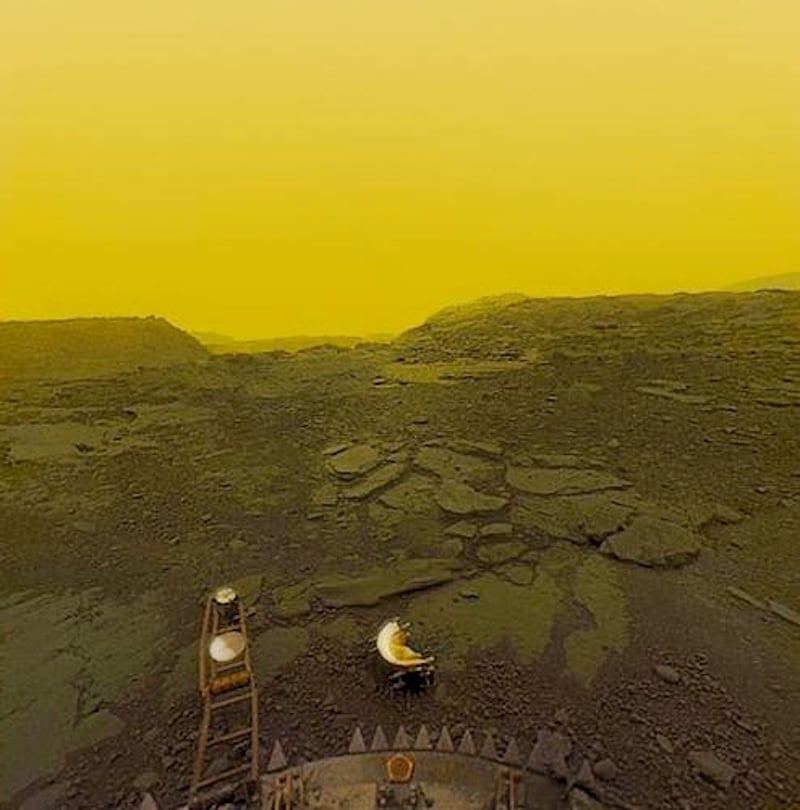
Every piece of electronics ever sent to Venus has been destroyed within hours of landing, cooked alive by surface temperatures hot enough to melt lead. Now a team of engineers at the University of Southern California has built a memory chip that laughs in the face of that heat, surviving temperatures hotter than molten lava and it started with a happy accident!
This latest collection of imagery via NASA shows us proof.
In newly released imagery from NASA, planets once seen as distant points of light are fully revealed in extraordinary detail.
Below are the planets in their natural order. The clarity is stunning.
Mercury The smallest planet and closest to the Sun, Mercury is a cratered, airless world that resembles our Moon. With almost no atmosphere, temperatures swing from blistering heat to deep cold. Vast impact basins and ancient lava plains reveal a violent early past.Venus Similar in size to Earth but far harsher, Venus is wrapped in thick clouds of carbon dioxide and sulfuric acid. A runaway greenhouse effect makes it the hottest planet in the solar system.Earth Our home world is the only known planet with life. Oceans cover most of its surface, and a balanced atmosphere helps maintain stable temperatures.Mars Mars is a cold desert world coated in iron-rich dust that gives it its red color. Giant features like Olympus Mons and Valles Marineris hint at a dramatic geological past.Jupiter The largest planet, Jupiter is a swirling giant of hydrogen and helium. Its colorful bands and the centuries-old Great Red Spot reveal a world of immense storms.Saturn Saturn is famous for its magnificent rings, made of billions of icy fragments. Beneath them lies a vast gas giant with powerful winds and dozens of moons.Uranus Uranus is an icy blue giant tipped dramatically on its side, likely from an ancient collision. Its unusual tilt creates extreme seasons that last decades.Neptune The most distant major planet, Neptune is a deep-blue world of powerful storms and the fastest winds in the solar system.Pluto Once considered the ninth planet, Pluto is now classified as a dwarf planet in the distant Kuiper Belt. Despite its small size, it features icy mountains, nitrogen glaciers, and the famous heart-shaped region called Tombaugh Regio. A small world, but a fascinating one.
 Log in