17706 stories
·
175 followers

In 1995, a Netscape employee wrote a hack in 10 days that now runs the Internet

1 Share

Thirty years ago today, Netscape Communications and Sun Microsystems issued a joint press release announcing JavaScript, an object scripting language designed for creating interactive web applications. The language emerged from a frantic 10-day sprint at pioneering browser company Netscape, where engineer Brendan Eich hacked together a working internal prototype during May 1995.

While the JavaScript language didn’t ship publicly until that September and didn’t reach a 1.0 release until March 1996, the descendants of Eich’s initial 10-day hack now run on approximately 98.9 percent of all websites with client-side code, making JavaScript the dominant programming language of the web. It’s wildly popular; beyond the browser, JavaScript powers server backends, mobile apps, desktop software, and even some embedded systems. According to several surveys, JavaScript consistently ranks among the most widely used programming languages in the world.

In crafting JavaScript, Netscape wanted a scripting language that could make webpages interactive, something lightweight that would appeal to web designers and non-professional programmers. Eich drew from several influences: The syntax looked like a trendy new programming language called Java to satisfy Netscape management, but its guts borrowed concepts from Scheme, a language Eich admired, and Self, which contributed JavaScript’s prototype-based object model.
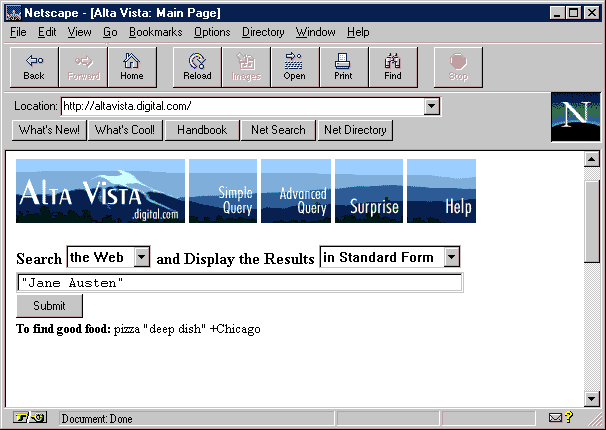
A screenshot of the Netscape Navigator 2.0 interface. A screenshot of the Netscape Navigator 2.0 interface. Credit: Benj Edwards

The JavaScript partnership secured endorsements from 28 major tech companies, but amusingly, the December 1995 announcement now reads like a tech industry epitaph. The endorsing companies included Digital Equipment Corporation (absorbed by Compaq, then HP), Silicon Graphics (bankrupt), and Netscape itself (bought by AOL, dismantled). Sun Microsystems, co-creator of JavaScript and owner of Java, was acquired by Oracle in 2010. JavaScript outlived them all.

What’s in a name?

The 10-day creation story has become programming folklore, but even with that kernel of truth we mentioned, it tends to oversimplify the timeline. Eich’s sprint produced a working demo, not a finished language, and over the next year, Netscape continued tweaking the design. The rushed development left JavaScript with quirks and inconsistencies that developers still complain about today. So many changes were coming down the pipeline, in fact, that it began to annoy one of the industry’s most prominent figures at the time.

“Bill Gates was bitching about us changing JS all the time,” Eich later recalled of the fall of 1996. Microsoft created its own implementation called JScript for Internet Explorer, leading to years of browser incompatibility that plagued web developers.

Before finalizing on the title “JavaScript,” the language cycled through multiple names. Eich initially called his prototype “Mocha,” then Netscape renamed it LiveScript for the September 1995 beta release of Netscape 2.0. The JavaScript name arrived in December when Netscape and Sun finalized their partnership. “It was all within six months from May till December (1995) that it was Mocha and then LiveScript,” Eich explained in a 2008 interview with InfoWorld. “And then in early December, Netscape and Sun did a license agreement and it became JavaScript.”
Credit: Oracle

That name has been a source of confusion for three decades. It was a marketing decision meant to capitalize on the buzz around Java at the time. The 1995 press release prominently positioned JavaScript as a complement to Java, with the former handling small client-side tasks while Java powered larger enterprise applications. Bill Joy, Sun’s co-founder and vice president of research, said at the time: “JavaScript will be the most effective method to connect HTML-based content to Java applets.”

Confusion about its relationship to Java continues: The two languages share a name, some syntax conventions, and virtually nothing else. Java was developed by James Gosling at Sun Microsystems using static typing and class-based objects. JavaScript uses dynamic typing and prototype-based inheritance. The distinction between the two languages, as one Stack Overflow user put it in 2010, is similar to the relationship between the words “car” and “carpet.”

From coffee name to industry standard

Industry standardization of JavaScript arrived in June 1997 through ECMA International as ECMAScript (with “ECMA” being short for “European Computer Manufacturers Association”). The language went through a rocky period in the early 2000s, when Internet Explorer dominated the browser market and innovation stalled somewhat, but the 2005 introduction of AJAX revitalized interest by enabling smoother web applications without full page reloads. Node.js arrived in 2009, letting developers run JavaScript on servers, and the language’s scope expanded far beyond the browser.

Today, JavaScript appears across virtually every corner of web development. The Stack Overflow Developer Survey for 2024 found that 62 percent of developers use JavaScript, making it the single most popular programming language (web or otherwise) for the twelfth year running. JetBrains’ State of Developer Ecosystem Report placed JavaScript at 61 percent usage among surveyed developers, with TypeScript, a JavaScript superset that adds static typing, growing from 12 percent adoption in 2017 to 35 percent in 2024.

The language now powers not just websites but mobile applications through frameworks like React Native, desktop software through Electron, and server infrastructure through Node.js. Somewhere around 2 million to 3 million packages exist on npm, the JavaScript package registry.

Today, people want to free the JavaScript trademark for public use. Oracle inherited the mark when it acquired Sun Microsystems, but the company has never built a product using the JavaScript name. An open letter signed by Eich, Node.js creator Ryan Dahl, and more than 28,000 members of the JavaScript community argues that Oracle has abandoned the trademark through non-use and that the term has become generic.

The group filed a petition for cancellation with the US Patent and Trademark Office in November 2024. Without risking a legal trademark challenge against Oracle, the letter notes, there can be no “JavaScript Conference” or “JavaScript Specification,” forcing community organizations to use awkward workarounds like “JSConf.” Eich himself wrote in 2006 that “ECMAScript,” the official name for the language standard, “was always an unwanted trade name that sounds like a skin disease.”

Skin disease or not, the underlying language stuck around far longer than anyone expected. Perhaps the biggest irony of all is that Java applets largely vanished from browsers years ago, but JavaScript dominates. The freaky sideshow became the main event. Happy birthday, JavaScript.

Read full article

Comments


Read the whole story
fxer
1 hour ago
reply
Bend, Oregon
Share this story
Delete

Guitar amp sims have gotten astonishingly good

1 Share

It’s an incredible time to be a guitarist who doesn’t want to own a bunch of $2,000 amps and an expensive pedalboard of gear. Amp and pedal simulators, which have been around for decades, have in the last few years finally come into their own as nearly indistinguishable sonic replacements. Even John Mayer is now willing to ditch his beloved tube amps for digital models.

I certainly don’t have Mayer’s chops or gear budget, but I do love messing with this sort of tech and have purchased everything from NeuralDSP‘s Archetypes series to Amplitube and Guitar Rig. Last week, as part of an early Black Friday sale, I picked up two amp/effects suites from British developer Polychrome DSP—Nunchuck (Marshall amps) and Lumos (clean through mid-gain tones). They are both excellent.

Any reasonable person should be satisfied with this tech stack, which models gear that collectively costs as much as my house. After my Polychrome DSP purchases, I reminded myself that I am a reasonable person, and that I could therefore ignore any further amp sims that might tempt my wandering eye.

And then on Monday, Universal Audio, one of the premier names in audio technology, released Paradise Guitar Studio. Unfortunately for my wallet, it is amazing.

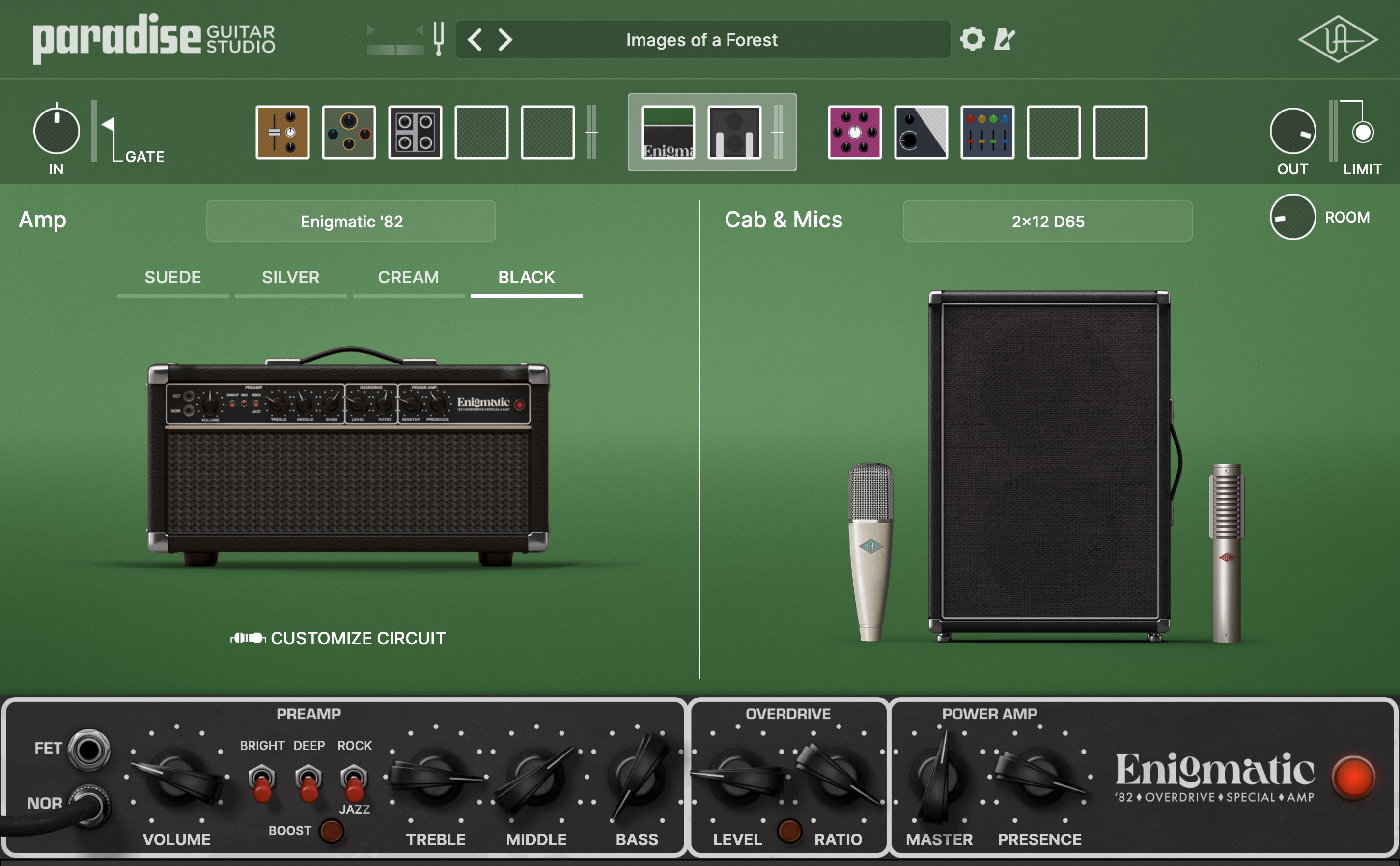
Paradise’s Dumble amp sim is terrific.
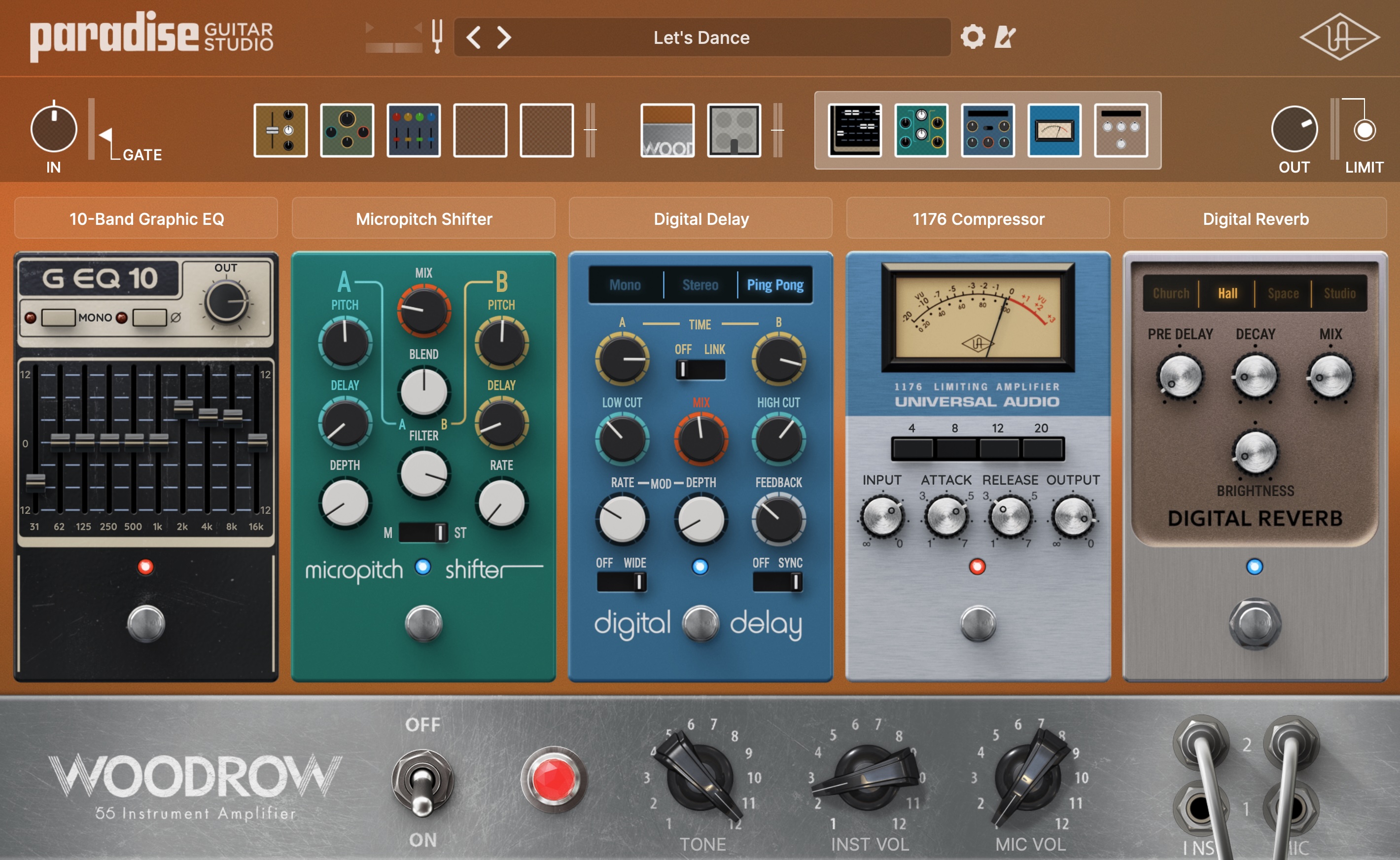
Two tickets to Paradise

Universal Audio—henceforth “UA”—has been developing top-tier emulation of classic studio gear for many years. More recently, they have also released a set of modelled amps in both plugin and physical pedal form, with each pedal going for over $300.

With Paradise Guitar Studio, the company has brought most (though not all; Anti and Knuckles are not included) of these amps into a single plugin, then paired them with a generous suite of tone-shaping gear, including six classic distortion pedals, seven modulation effects units, a couple of compressors, four delays, four reverbs, and a couple of EQs.

As for the amps, you get six: a few Fenders, a Marshall, a Vox AC 30, and a Dumble. Most of these have several variants and small mods; the Dumble alone features four different iterations of the legendary boutique hardware, and it gives you the ability to tweak the main Dumble circuit by altering capacitor values and internal trim levels.

Each amp comes with a specially selected set of cabinet and mic emulations, and in Paradise, you can use any amp with any set of mics and cabs. Want to pair a Fender Twin Reverb with a 4×12 Marshall cabinet miced by two SM57s? Go for it.

You can have up to 10 effects units, five in front of the amp and five after it.
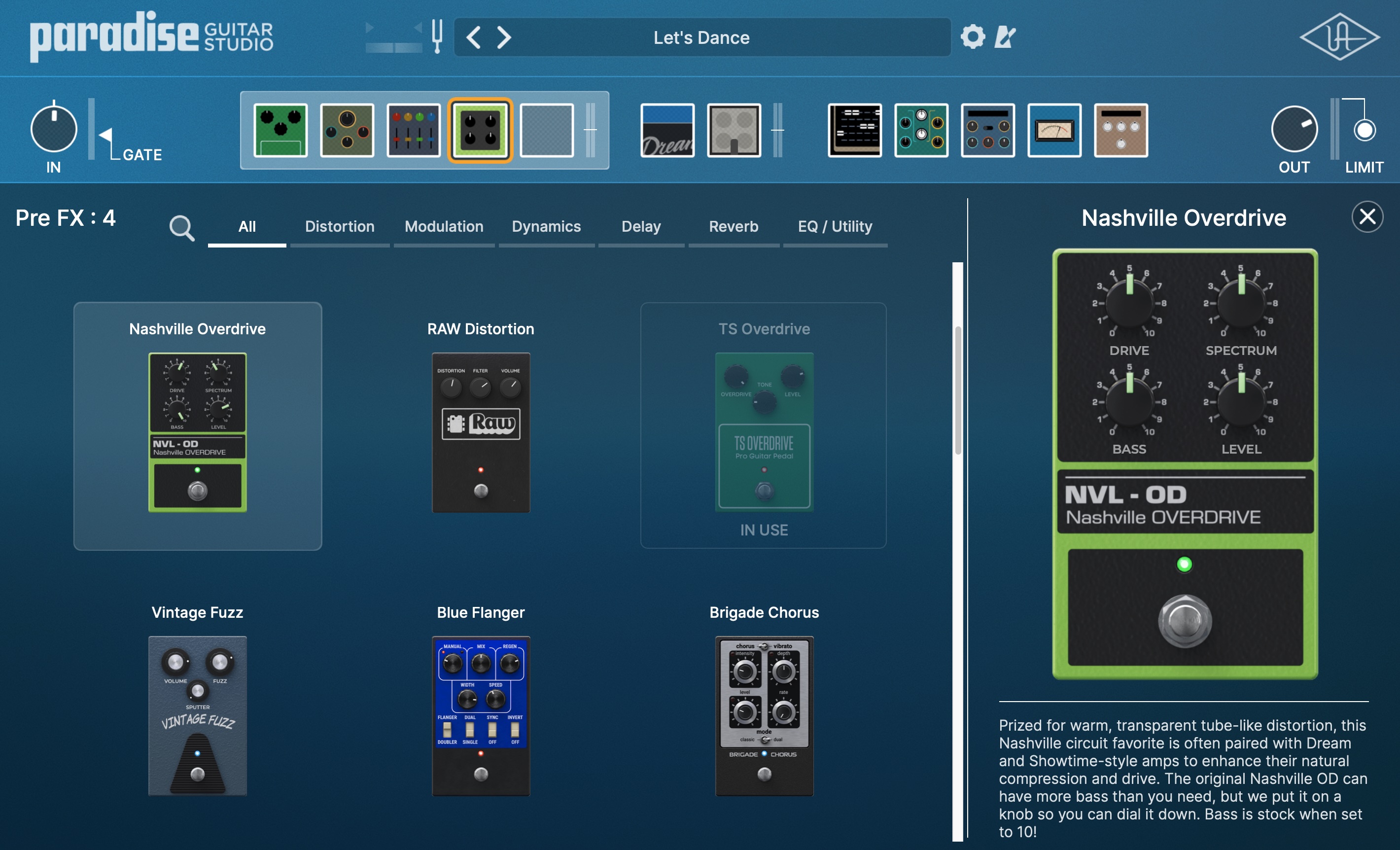
The tone is astonishing. UA is well-known for its emulations of 1176 compressors, tape delays, and Lexicon reverb units, and all that gear has been shoved into Paradise. (Some of the controls are simplified, but this appears to be the “full-fat” version of these tools under the hood.) Plus, each amp allows you to control the amount of “room tone” captured by the mics, and this room simulation is terrifically convincing.

Paradise hits the sweet spot—for me, at least—of offering options without overload. You can place five effects before the amp and cab and five after. The interface is large and clear, with chunky buttons and knobs, and it’s simple to create a new pedalboard and dial in a tone. It doesn’t hurt that Paradise comes with several hundred presets, which are very good indeed.

While I think Paradise, Polychrome DSP, and NeuralDSP all edge out products like Amplitube on sound quality, they really win by being more fun to use. Amplitube is a mess of a bazillion amps and effects that you can arrange in complex routing chains: splitting signals, running DIs, maneuvering virtual mics near virtual speaker cones, selecting room tone, and twiddling a bajillion almost illegible knobs. It’s too much. At some point, all the choice works against creativity.

I whipped up two short demos in Paradise in a couple of hours, just to show the kinds of tones on offer here. (You can listen below.) One uses lots of 80s-style rock tones, while the other showcases some edge-of-breakup tones on the Dumble. No fancy gear was used, just a cheap PRS guitar and a generic Craigslist bass plugged directly into an audio interface in my office.

Rock ‘n roll will never die! (Unless I kill it). [above]

Breakup tones from a Dumble amp sim. [above]

Downsides? Well, like many UA products, Paradise is expensive. The “intro price” is $149, though there is a loyalty offer for anyone who owns previous UA amp sims. Given that NeuralDSP and Polychrome DSP both just had 50 percent off sales, and that Amplitube is practically being given away at this point, you might spend more on Paradise. Still, you get a lot for that money, and the patient will likely find Paradise on a big sale within the next year.

It’s likely to sting more for people who have already invested in UA’s amp plugins and who will now find them nearly obsolete. Even with a $79 upgrade price, loyal UA users might find themselves spending more in total than new buyers to get Paradise.

Some of the pedals on offer.

Second, Paradise is plugin-only. There’s no standalone version of the software, so starting a practice session requires firing up a DAW like Logic or Pro Tools, adding Paradise to an open track, and configuring inputs and monitoring—annoying extra work if you’re not recording anything. Amplitube, Guitar Rig, Lumos, Nunchuck, and the NeuralDSP collections all work either as plugins or standalone applications. It’s a strange but significant oversight in functionality.

Finally, there’s the sound. Paradise sounds great, but it seems largely built around classic rock tones from the ‘60s through the ‘90s, and most of the preset names reflect this. If you’re a high-gain metal player, this is probably not your best option at the moment; go with NeuralDSP or similar instead. Similarly, if you’re a more modern or experimental player, you might want something like Guitar Rig, which has some truly gonzo effects units, or Polychrome’s McRocklin suite.

But this is mere carping. In reality, there has never been a better time to be a guitar player. Even bedroom strummers can now sound like guitar gods for minimal cash (and without shaking the floors, waking the neighbors, or warming up the tubes first).

Like all tools, the sign of a good amp simulation suite is that it unlocks creativity. I’ve lost hours to each of the top amp sims mentioned here, tweaking tones and stumbling through presets until suddenly coming upon one that instantly suggests a song, a vibe, or a rhythmic figure. The same has been true so far of Paradise, which sounds so good that I just keep wanting to pick up the guitar. And isn’t that the goal?

Read full article

Comments


Read the whole story
fxer
1 day ago
reply
Bend, Oregon
Share this story
Delete

Netflix quietly drops support for casting to most TVs

1 Share

Have you been trying to cast Stranger Things from your phone, only to find that your TV isn’t cooperating? It’s not the TV—Netflix is to blame for this one, and it’s intentional. The streaming app has recently updated its support for Google Cast to disable the feature in most situations. You’ll need to pay for one of the company’s more expensive plans, and even then, Netflix will only cast to older TVs and streaming dongles.

The Google Cast system began appearing in apps shortly after the original Chromecast launched in 2013. Since then, Netflix users have been able to start video streams on TVs and streaming boxes from the mobile app. That was vital for streaming targets without their own remote or on-screen interface, but times change.

Today, Google has moved beyond the remote-free Chromecast experience, and most TVs have their own standalone Netflix apps. Netflix itself is also allergic to anything that would allow people to share passwords or watch in a new place. Over the last couple of weeks, Netflix updated its app to remove most casting options, mirroring a change in 2019 to kill Apple AirPlay.

The company’s support site (spotted by Android Authority) now clarifies that casting is only supported in a narrow set of circumstances. First, you need to be paying for one of the ad-free service tiers, which start at $18 per month. Those on the $8 ad-supported plan won’t have casting support.

Even then, Casting only appears for devices without a remote, like the earlier generations of Google Chromecasts, as well as some older TVs with Cast built in. For example, anyone still rocking Google’s 3rd Gen Chromecast from 2018 can cast video in Netflix, but those with the 2020 Chromecast dongle (which has a remote and a full Android OS) will have to use the TV app. Essentially, anything running Android/Google TV or a smart TV with a full Netflix app will force you to log in before you can watch anything.

Streaming lockdown

Frequent travelers have long appreciated the prevalence of Google Cast support. You can drop into an Airbnb and begin streaming content to a big screen from your phone without typing your credentials into a TV you don’t own. Not only is logging into TVs often logistically annoying, but you must also remember to log out again later, and Netflix likes to hide that option.

Netflix help The Netflix help page is not very helpful. Credit: Netflix
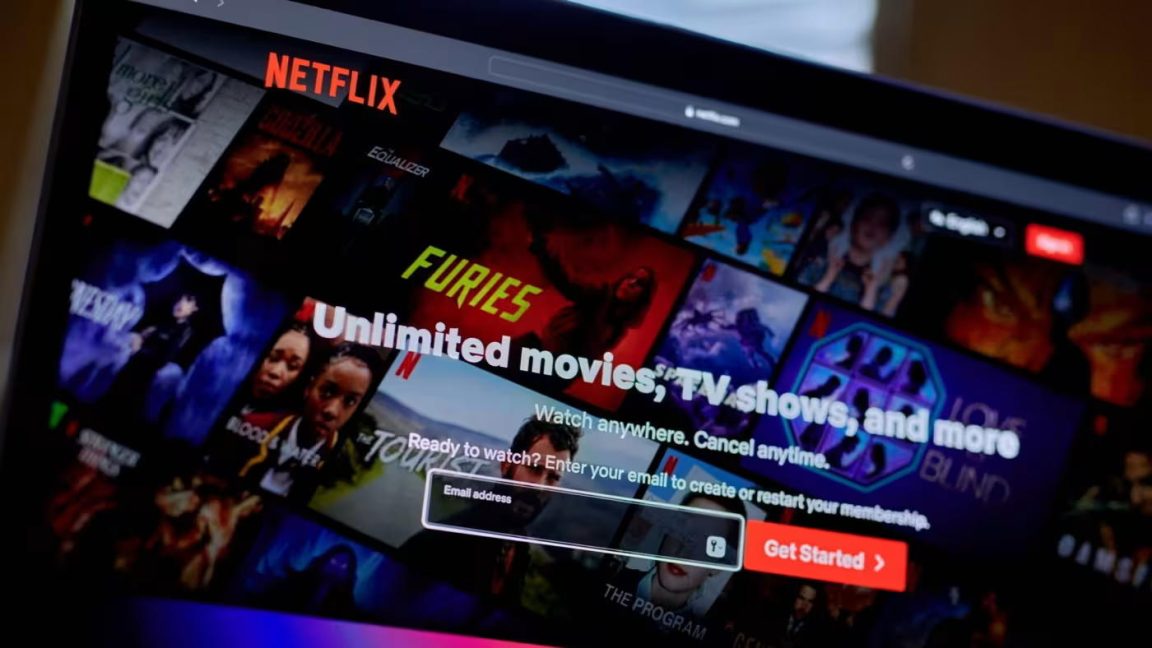
Netflix has every reason to want people to log into its TV apps. After years of cheekily promoting password sharing, the company now takes a hardline stance against such things. By requiring people to log into more TVs, users are more likely to hit their screen limits. Netflix will happily sell you a more expensive plan that supports streaming to this new TV, though.

Netflix is also building a very particular kind of TV experience that pushes people to watch more content with a never-ending reel of previews and trailers. Engagement is now one of the primary metrics Netflix reports to investors. You can’t do that when people are only watching a single item at a time via casting sessions.

There are definitely Netflix subscribers up in arms about this change. Many claim to be frequent travelers who don’t want to log into new TVs in every Airbnb or hotel. However, the chorus of discontent is not as loud as it might have been in the past. Fewer people rely on casting support now that Google has retired the Chromecast brand to focus on more powerful streaming devices. At the same time, TV makers would be crazy to sell a screen without a certified Netflix app in 2025.

So Netflix may have a good reason to think it can get away with killing casting. However, trying to sneak this one past everyone without so much as an announcement is pretty hostile to its customers.

Read full article

Comments


Read the whole story
fxer
1 day ago
reply
Bend, Oregon
Share this story
Delete

Mad Men’s 4K debut botched by HBO Max streaming episode with visible crewmembers

1 Comment

Streaming services have a way of reviving love for old shows, and HBO Max is looking to entice old and new fans with this month’s addition of Mad Men. Instead, viewers have been laughing at the problems with the show’s 4K premiere.

Mad Men ran on the AMC channel for seven seasons from 2007 to 2015. The show had a vintage aesthetic, depicting the 1960s advertising industry in New York City.

Last month, HBO Max announced it would modernize the show by debuting a 4K version. The show originally aired in SD and HD resolutions and had not been previously made available in 4K through other means, such as Blu-ray.

However, viewers were quick to spot problems with HBO Max’s 4K Mad Men stream, the most egregious being visible crew members in the background of a scene.

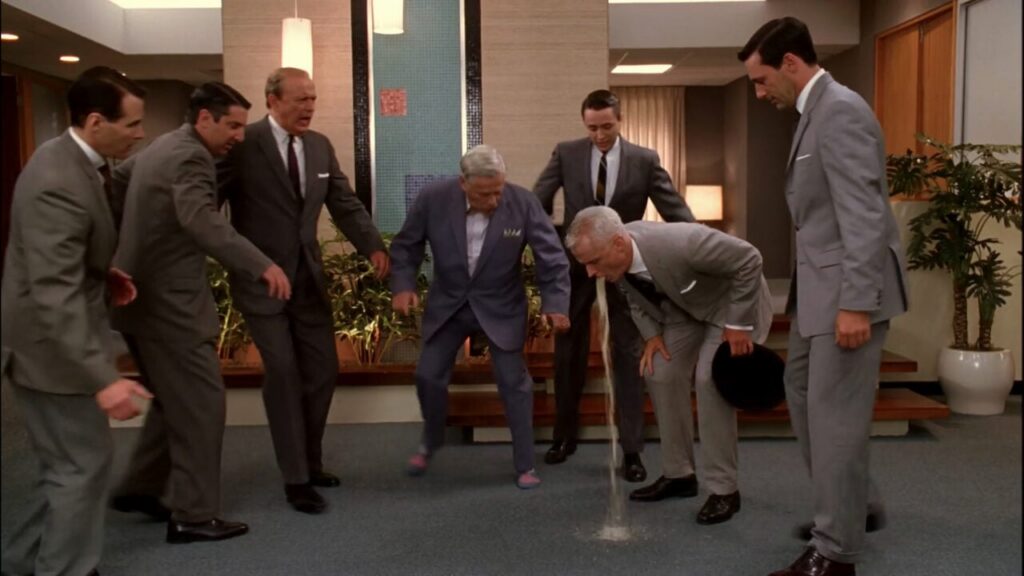
The episode was “Red in the Face” (Season 1, Episode 7), which was reportedly mislabeled. In it, Roger Sterling (John Slattery) throws up oysters. In the 4K version that was streaming on HBO Max, viewers could see someone pumping a vomit hose to make the fake puke flow.

How the scene looked when it aired on AMC. Credit: Lionsgate
You can see the crew members on the right side of the shot.
How the scene looked in 4K on HBO Max. You can see crew members on the right side. Credit: ceej.online via Bluesky/Lionsgate

The Hollywood Reporter, citing an anonymous source, said that the error happened because Mad Men production company Lionsgate gave HBO Max the wrong file. The publication reported that Lionsgate “was working on getting HBO Max the correct file(s)” and was readying to provide them at approximately 10 a.m. PT today. Neither Lionsgate nor HBO Max has commented.

The blunder is likely to be fixed for all viewers soon. There were no problems with the HD versions of HBO Max’s Mad Men stream. However, the mix-up is a revealing look at the complexities of bringing a show or movie to a new distribution platform, how moving to wider aspect ratios or higher resolutions can affect shots, and how important human reviews are for avoiding embarrassing mistakes.

There have been other instances of show remasters inadvertently showing viewers how the sausage was made. For example, a 2020 HD remaster of Buffy the Vampire Slayer (1997–2001) that took the show from a 4:3 aspect ratio to 16:9 had episodes with visible crew and equipment in addition to “brightly lit and overexposed scenes,” Screen Rant reported at the time. When Seinfeld (1989–1998) came to Netflix, a plot-centric pothole that annoyed George Costanza (Jason Alexander) was cut from some shots, as noted by Wired.

Read full article

Comments


Read the whole story
fxer
1 day ago
reply
That’s just what barf machines looked like in 1963
Bend, Oregon
Share this story
Delete

75 years later, Thanksgiving staple Jiffy corn muffin mix still costs less than $1

3 Shares
Jiffy corn muffins have been an American family dinner staple for 75 years.

Jiffy corn muffins are an iconic, low-cost pantry staple introduced during the Depression. Thanksgiving is peak season for the company, which has been run by the same family for five generations.

Read the whole story
fxer
5 days ago
reply
Bend, Oregon
Share this story
Delete

Epic's Sweeney Says Platforms Should Stop Tagging Games Made With AI

2 Comments
The CEO of Epic Games, Tim Sweeney, has argued that platforms like Steam should not label games that are made using AI. From a report: Responding to a post on Twitter from a user who suggested that storefronts drop this tag, the industry exec said that it "makes no sense" to flag such content. Sweeney added that soon AI will be a part of the way all games are made. "The AI tag is relevant to art exhibits for authorship disclosure, and to digital content licensing marketplaces where buyers need to understand the rights situation," Sweeney said. "It makes no sense for game stores, where AI will be involved in nearly all future production."
Read the whole story
fxer
5 days ago
reply
I’d be amazed if a single game is being made without Claude assisting.
Bend, Oregon
Share this story
Delete
1 public comment
jepler
6 days ago
reply
oh now I know why people were dissing on sweeny on the socials today
Earth, Sol system, Western spiral arm
Next Page of Stories