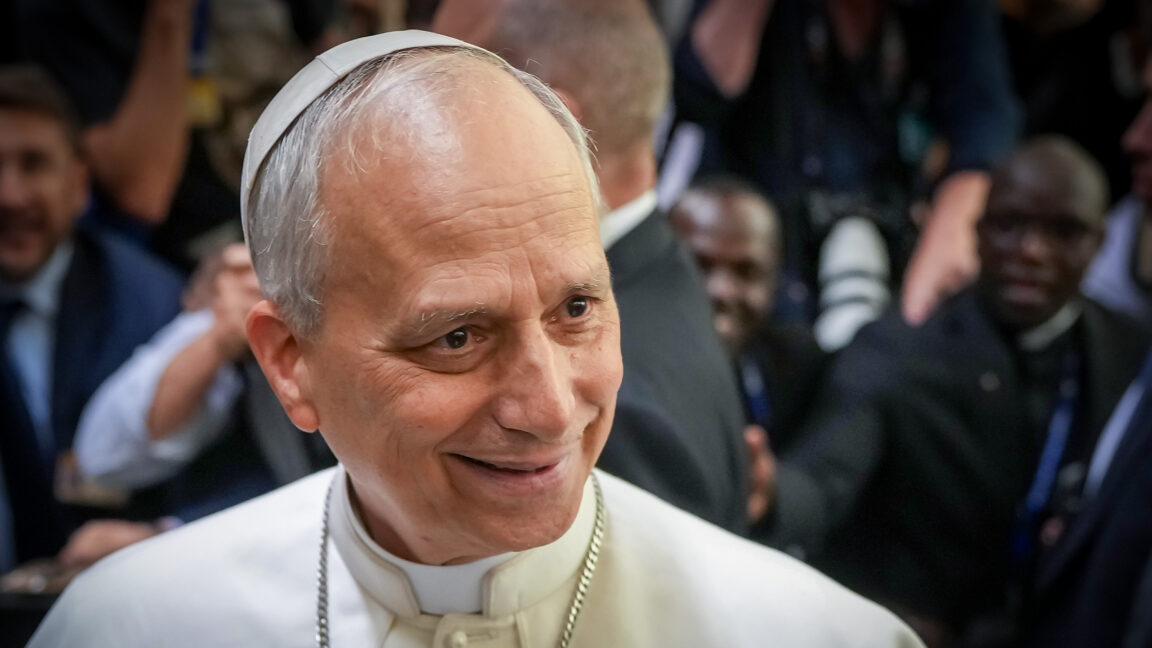
I'm not suggesting that a man like Pope Leo—the Vicar of Christ, the Bishop of Rome, the Servant of the Servants of God—would stoop to anything quite so base as "trolling" the onetime PayPal co-founder and current Antichrist alarmist Peter Thiel. But I'm also not not suggesting it, if you see what I mean.
How else to explain the novel appearance of Gandalf—yes, the pipe-smoking wizard!—in the pages of one of Catholicism's most important documents, a major papal encyclical about AI and technology? Perhaps Leo, who was born and raised in Chicago before spending decades in Peru, is simply a big J.R.R. Tolkien buff who can't get enough of magic rings, Eldar lore, and tricksy little hobbitses. Or perhaps Leo is sending a message.
In his new encyclical, released yesterday, Leo quotes one literary character in the entire 40,000-word document. It's Gandalf, doling out some of his wisdom in a scene from Return of the King: “It is not our part to master all the tides of the world, but to do what is in us for the succour of those years wherein we are set, uprooting the evil in the fields that we know, so that those who live after may have clean earth to till.”
Leo connects this speech with the "civilization of love" that he calls for in the document, stressing (as Tolkien did) the importance of "small and steadfast acts of fidelity that serve as a bulwark against dehumanization."
The Gandalf quote, innocuous on its own, feels more pointed when you realize how Tolkien is valorized (Valar-ized?) in conservative tech circles today. Peter Thiel is one of the most powerful people in such circles—and he is a Tolkien fanboy in the worst way.
Fellowship of the bling
As far back as 2012, people were running articles on how "Peter Thiel, the first outside investor in Facebook, is a huge fan of J.R.R. Tolkien's Lord of the Rings series of fantasy books."
Business Insider noted that "Thiel's inner circle seems well aware of his fondness for Tolkien's world of elves and magic. One source who claims to be close to Thiel says there's an in-joke about his venture-capital firm, the Founders Fund, being nicknamed 'The Precious.'"
Thiel has named many of his companies after Tolkien's world. He co-founded the AI-focused Palantir. He launched Mithril Capital Management. He co-founded the fintech venture capital firm Valar Ventures. He has other companies named Rivendell One and Lembas LLC.
Thiel protégés include current US Vice President J.D. Vance, who has called Tolkien his favorite author and who once founded a venture capital firm called Narya (one of the Elvish rings of power).
Palmer Luckey, who launched his own Tolkien-themed tech/defense startup called Anduril, is also "launching a new digital bank with backing from Peter Thiel," Fortune reported last year. The bank's name? Erebor, naturally, another name for the Lonely Mountain, where Smaug slept atop piles of gold in The Hobbit.
Thiel and his circle like a good fantasy story. So what? According to The New York Times, even the current leader of Italy, Giorgia Meloni, used to cosplay Tolkien characters and attend "Hobbit Camps," where she "sang along with the extremist folk band Compagnia dell’Anello, or Fellowship of the Ring."
But Thiel isn't just one more investor with a Tolkien fetish. He has also been proclaiming a fairly idiosyncratic version of Christianity for years. His message has recently taken the form of a multi-night, four-lecture series about the looming dangers of "the Antichrist," a figure drawn from the Book of Revelation who opposes everything Jesus stood for.
And he doesn't seem to be a big fan of the Pope.
The Antichrist loves peace and safety
Thiel's Antichrist tour has taken him around the world, including Rome, where earlier this year the Associated Press said that Thiel's "invitation-only conference" became "so controversial that the Catholic universities initially associated with it have all denied official involvement."
While the lectures have been private, recordings of them have leaked. The Guardian has a nice write-up on them, saying that Thiel's "beliefs are diffuse, meandering, and often confusing, but one tenet he’s steadfastly maintained over the years is that the unification of the world under one global state is essentially identical to the Antichrist."
Thiel worries especially about a "woke American pope" making common cause with a "woke American president," which could lead to the world domination he fears.
You can see how Thiel's ideas—I use the word with hesitation—might come to the attention of the current, US-born Pope. But Popes don't generally stoop to Tolkien-quote battles with those who dislike them, so why now?
Perhaps it's because Thiel, despite his professed Christianity, represents a sort of tech messianism. It is technology that could save the world from the "stagnation" that grips it, he said repeatedly on a New York Times podcast interview in 2025. And the technology that could best help break this cultural stagnation is AI. Therefore, we should take the guardrails off AI, despite the risks.
I still think we should be trying AI, and that the alternative is just total stagnation. So yeah, there’s all sorts of interesting things can happen with—maybe drones in a military context are combined with AI. And OK, this is scary or dangerous or dystopian, or it’s going to change things. But if you don’t have AI, wow, there’s just nothing going on.
I'm old enough to remember life before AI. It certainly seemed like some things were going on. But to Thiel, people and governments who stand in the way of AI—especially if they in some sense represent the dreaded one-world governance of his nightmares—are themselves possible Antichrists.
If you think I'm making this theory sound crazier than it is, here's Thiel saying that his worries about "peace and safetyism"—i.e., regulation—are directly linked to the Antichrist:
But is this so preposterous, what I’ve just told you, as a broad account of the stagnation that the entire world has submitted to for 50 years of peace and safetyism? This is a 1 Thessalonians 5:3—the slogan of the Antichrist is peace and safety.
[Ed. note: The New Testament's first letter to the Thessalonians says, "You know very well that the day of the Lord will come like a thief in the night. While people are saying, 'Peace and safety,' destruction will come on them suddenly, as labor pains on a pregnant woman, and they will not escape." The quote emphasizes that the "day of the Lord" will be a total surprise, not that it was caused by people trying to stop wars or require airbags in cars.]
And we’ve submitted to—the FDA regulates not just drugs in the US, but de facto in the whole world because the rest of the world defers to the FDA. The Nuclear Regulatory Commission effectively regulates nuclear power plants all over the world.
In this view, Pope Leo's strident call to "disarm" AI is therefore aligned with the forces of stagnation that are used by the Antichrist to stage his or her world takeover.
Leo seems in his encyclical to be sketching a completely different vision, showing Thiel and his Silicon Valley friends that there's another way to "build." Not in a world-bestriding, revolutionary way that seeks to earn a billion dollars while strapping AI vision systems onto cruise missiles, but in a quieter way, with love and charity worked out in our local field of action.
Or, as Gandalf put it above, "to do what is in us for the succour of those years wherein we are set, uprooting the evil in the fields that we know, so that those who live after may have clean earth to till."
Leo thus calls for tech to shed its messianic and neo-colonial tendencies in order to serve humanity; Thiel instead sees tech as a savior to the poor and oppressed, a force that can head off Armageddon and Antichrist.
Thiel's vision of tech saving the world through unloosed, Saruman-style AI industrialists would be far more compelling if so many of these tech giants were not such strangely immature and insecure people.
But don't take my word for it. Here's Thiel himself, telling The New York Times' Ross Douthat about a meeting he once helped broker between top AI leader Demis Hassabis and Elon Musk:
The rough conversation was Demis telling Elon: I’m working on the most important project in the world. I’m building a superhuman A.I.
And Elon responds to Demis: Well, I’m working on the most important project in the world. I am turning us into interplanetary species.
And then Demis said: Well, you know my A.I. will be able to follow you to Mars.
And then Elon sort of went quiet...
Thiel himself sums up this meeting of the minds: "It was the dumbest meeting with Elon that we sort of brokered."
Proclamation in the shade
I'm not the only one to raise this question about the Pope's encyclical, of course.
The Catholic Herald asked, "Is Magnifica Humanitas aimed at Peter Thiel’s techno-political empire?"
Or, as tech blogger Simon Willison wrote, "I can’t help but wonder if the J.R.R. Tolkien quote from The Return of the King was the Pope throwing a little shade at Peter Thiel."
But I don't think this Pope operates according to categories like "throwing shade." As we saw when Leo tangled with Donald Trump over his war of choice in Iran, Leo sees his job as preaching and proclaiming.
"The mission of the Church is to proclaim the Gospel, to preach peace," Leo said at the time. "I simply hope to be listened to because of the value of the word of God."
His Gandalf quote may well be targeted at Thiel, or perhaps more broadly at those who think in similar ways. But it is not confrontational or insulting. It is a way of speaking across differences using a line drawn from a shared cultural resource between the two camps. It offers up a new interpretation of Tolkien's tremendous work to those who see in it a license for warfare, technological disruption, battles, and global action. Those things exist in the story, and they are exciting, but they are also terrifying and ultimately endured only for the purpose of defending community, hearth, and home.
In Tolkien's world, it is the "little people"—indeed, it is the wretched outcast Gollum—who finally save the world from the battles and technologies of the "great," and thus it is in the limited world of the hobbits that the action begins and ends.
It is in this sense, I think, that the Pope offers a different vision to the tech aristocrats of today. He explicitly asks them to give up their dreams of transhumanism and "artificial" intelligences—and to replace those dreams with something more truly human.
Read full article
Comments
 Log in