
17857 stories
·
173 followers

OPEC Shakeup

1 Share

Seems like kind of a big deal:

The United Arab Emirates will next month leave OPEC, a cartel of oil-producing countries, its government said on Tuesday, a decision that will weaken the group’s influence over global energy markets.

Emirati officials had long floated the idea of quitting the cartel, complaining that its quotas had unfairly curtailed its oil exports.

The government is now expected to increase its energy production to serve its own national interests. Before the war, the Emirates was producing about 3.6 million barrels of oil per day, according to the International Energy Agency — roughly 12 percent of OPEC’s overall production. OPEC countries supplied more than a quarter of the world’s oil before the war with Iran.

A coalition of the world’s largest oil exporters, OPEC was able to steer prices by setting quotas for those countries. But the organization’s power had slipped in recent years as U.S. oil production soared.

I don’t have a good sense for the immediate impact of this… obviously when you’re a consumer and not a producer weakening a cartel is on balance a good thing, although oil markets are so complex and I confess I can’t fully understand the downstream implications. Does seem to suggest a pretty significant political rift between UAE and KSA, though, and that’s undoubtedly related to the prosecution of the war.

The post OPEC Shakeup appeared first on Lawyers, Guns & Money.

Read the whole story
fxer
1 hour ago
reply
Bend, Oregon
Share this story
Delete

Every asshole for himself

1 Share

I’m not even the biggest fan of billionaire’s taxes, which can be a cousin of the slopulist idea that it’s possible to fund a generous welfare state by taxing only the very wealthy. But the lengths plutocrats who will not be materially affected by such a tax in any way will go to stop them remains embarrassing:

It was a holiday party at a crypto titan’s estate in Marin County, and Sergey Brin had a bone to pick with Gavin Newsom.

Mr. Brin, a Google co-founder and one of the world’s richest people, is a longtime friend of Mr. Newsom, the California governor. Both men attended each other’s weddings. But now Mr. Brin pulled Mr. Newsom aside to a different part of the property for a serious talk.

Mr. Brin told Mr. Newsom that he could not stand the state’s proposed billionaire tax. They were soon joined by Mr. Brin’s girlfriend, Gerelyn Gilbert-Soto, a Trump-loving gut-health influencer. 

“Gut health influencer.” Please kill me.

Even as she tried to defuse the tension — joking that she would let Mr. Newsom’s bad policies slide because he was handsome — she argued that the measure would wreck California’s economy.

Mr. Newsom, who had never seemed inclined to support the tax, came out the next month and pledged to defeat it. He declined to comment on the interaction.

The December confrontation, which took place at a party thrown by the billionaire Chris Larsen and was recounted by three people briefed on it, reflected Mr. Brin’s new war footing. He is growing more politically agitated, more willing to spend his estimated $273 billion fortune on elections and evidently more receptive to Republican points of view.

Mr. Brin, 52, long showed little interest in politics. When he did, he embraced liberal causes: He donated to a campaign to defend same-sex marriage in California in 2008 and backed President Barack Obama’s re-election bid in 2012. He called President Trump’s election in 2016 “deeply offensive” in leaked comments to Google employees and then joined a protest against Mr. Trump’s ban on immigrants from several predominantly Muslim countries. In 2021, he quietly started a nonprofit group that has spent at least $88 million on climate and environmental policy.

But now, like so many other leaders in the traditionally liberal bastion of Silicon Valley, Mr. Brin has shifted to the right.

With his outspokenly conservative girlfriend by his side, he has joined the ranks of tech executives courting Mr. Trump in his second term. Last May, he attended a fund-raiser featuring Vice President JD Vance and donated nearly half a million dollars to the Republican National Committee. In September, he told the president at a White House dinner that he was “very grateful” for the administration’s support of tech companies. This March, he was named to a White House tech council and donated to a Republican candidate for governor of California who has since earned Mr. Trump’s endorsement.

Mr. Brin is particularly rattled by the proposal for a one-time, 5 percent tax on California billionaires, and has emerged as Silicon Valley’s leading combatant of the measure. To escape the tax, he moved before a Dec. 31 deadline to the Nevada side of Lake Tahoe (he now spends every other week at Google’s California headquarters, alternating with Nevada, a person familiar with the arrangement said). And he has spent $57 million to try to undercut the measure, including $9 million more disclosed on Friday.

Brin’s net worth is north of $200 billion. The tax will not affect his descendants for generations let alone himself. But it’s enough for him to embrace fascism. It’s revolting.

The post Every asshole for himself appeared first on Lawyers, Guns & Money.

Read the whole story
fxer
11 hours ago
reply
Bend, Oregon
Share this story
Delete

"Super ZSNES" is a stab at a modern SNES emulator from the original developers

1 Share

Aficionados of game console emulator history will almost certainly be familiar with ZSNES, an MS-DOS-based (and, later, Windows-based) emulator for the Super Nintendo Entertainment System that originally launched back in 1997. Originally written in x86 assembly code, it was known best for its performance on low-end PCs and was capable of running some games at full speed on chips as slow as a 233 MHz Pentium II, though it usually did so at the expense of emulation accuracy.

ZSNES developed rapidly (alongside the contemporary, competing Snes9x project) throughout the late ’90s and early 2000s. Updates slowed after the original creators left the project, and new releases ceased entirely around 2007.

But a successor to ZSNES has arrived. The project's original creators (who go by the handles zsKnight and _Demo_) have returned 19 years later with a new follow-up project called "Super ZSNES," an SNES emulator that emphasizes audio-visual upgrades to those aging ’90s-era Super Nintendo games. The only more surprising emulator news would be if NESticle somehow rose from the dead.

Aside from the name, the developers, and an updated version of the falling-snow menu screen, Super ZSNES has nothing to do with the original project. The new emulator has been "re-written completely from scratch" with "no vibe coding." The emulator features "far more accurate CPU and Audio cores than the original ZSNES" and makes extensive use of GPU-based rendering instead of the mainly CPU-based emulation of the original and most other SNES emulators.

But the main selling point for Super ZSNES, and the reason for its existence alongside mature full-featured emulators like Snes9x and Higan/bsnes, is its new "super enhancement engine." These enhancement features go beyond typical image upscaling and screen filters, adding features like widescreen support and texture mapping that can optionally give supported games "a higher resolution look."

Super ZSNES can also replace the original audio samples with uncompressed versions ("restored" versions of SNES game soundtracks that claim to use uncompressed versions of the original audio samples are a whole thing), and can add actual 3D to games that use the Mode 7 effect rather than just upscaling it. These enhancements don't directly modify the ROM files, nor do they include data from ROMs, insulating the project from legal action.

An overview video by Modern Vintage Gamer shows many of these new updates in action, and they can definitely give old SNES games a dramatically different look and sound. They likely won't do much for the kinds of retro-game purists who spend their time looking for the perfect CRT filter, but they can give you something new to look at and listen to while you work on your 17th playthrough of Super Mario World.

These enhancements need to be created on a per-game basis, and the initial Super ZSNES release only includes enhancements for seven "popular games": F-ZeroGradius 3, the first Mega Man XSuper Castlevania 4Super Ghouls & GhostsSuper Mario World, and Super Metroid. The creators plan to add support for more games in the future, and players will also be able to create their own enhancements for individual games using tools built into the emulator.

The initial Super ZSNES release supports Windows, Intel and Apple Silicon Macs, Linux, and Android, with an iOS release "coming soon." Future releases will include general bug fixes and performance optimizations, support for popular enhancement chips like the DSP-1 and SuperFX, "more types of enhancements," online netplay, and more.

Read full article

Comments


Read the whole story
fxer
19 hours ago
reply
Bend, Oregon
Share this story
Delete

The electromechanical angle computer inside the B-52 bomber's star tracker http://www.righto.com/2026/04/B-52-star-tracker-angle-computer.html

2 Shares

Before GPS, how did aircraft navigate? One important technique was celestial navigation: navigating from the positions of the stars, planets, or the sun. While celestial navigation is accurate, cannot be jammed, and doesn't require any broadcast infrastructure, it is a difficult and time-consuming process to perform manually. In the early 1960s, an automated system was developed for the B-52 bomber to automatically track stars and compute navigation information. Digital computers weren't suitable at the time, so the star tracking system performed trigonometric calculations with an electromechanical analog computer called the Angle Computer.1
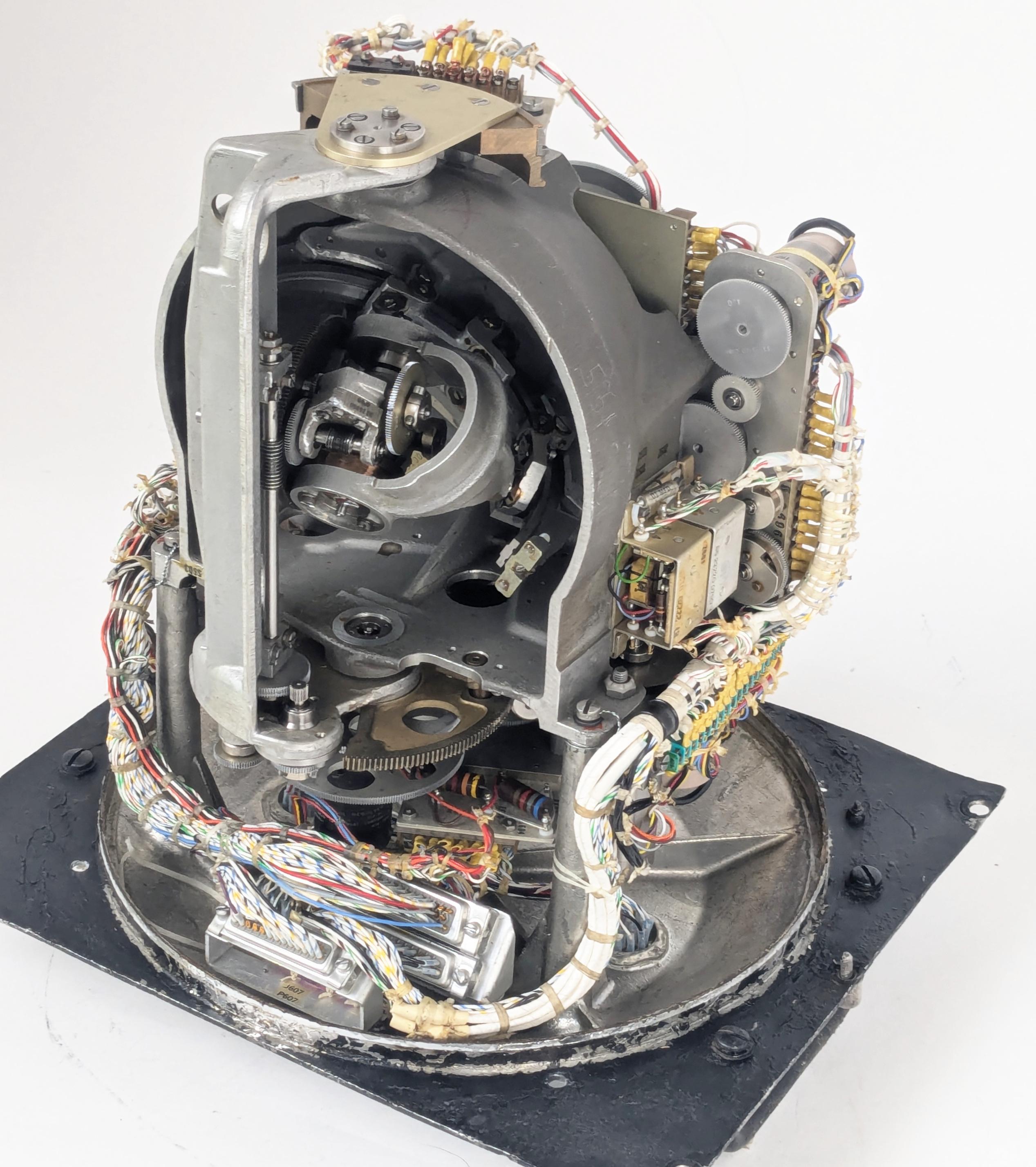
The Angle Computer contains complex electromechanical systems. Click this image (or any other) for a larger image.

The Angle Computer contains complex electromechanical systems. Click this image (or any other) for a larger image.

The photo above shows the mechanism inside the Angle Computer.2 Although it may look like a gyroscope or IMU (Inertial Measurement Unit), it is completely different and nothing is spinning. The Angle Computer physically models the "celestial sphere", with a complicated mechanism inside that moves a pointer that represents the position of a star. The corresponding angles (the azimuth and altitude) are read out electrically through devices called synchros, providing information to the navigation system through bundles of wires. In this article, I'll give an overview of how celestial navigation works and explain how the Angle Computer performs its calculations.

The Astro Compass system

The Angle Computer is one piece of the Astro Compass, a system that locked onto a star and produced a highly accurate heading (i.e., compass direction), accurate to a tenth of a degree. While the heading is the main output from the Astro Compass, the navigator can also use it to determine position, using the "lines of position" technique described later.
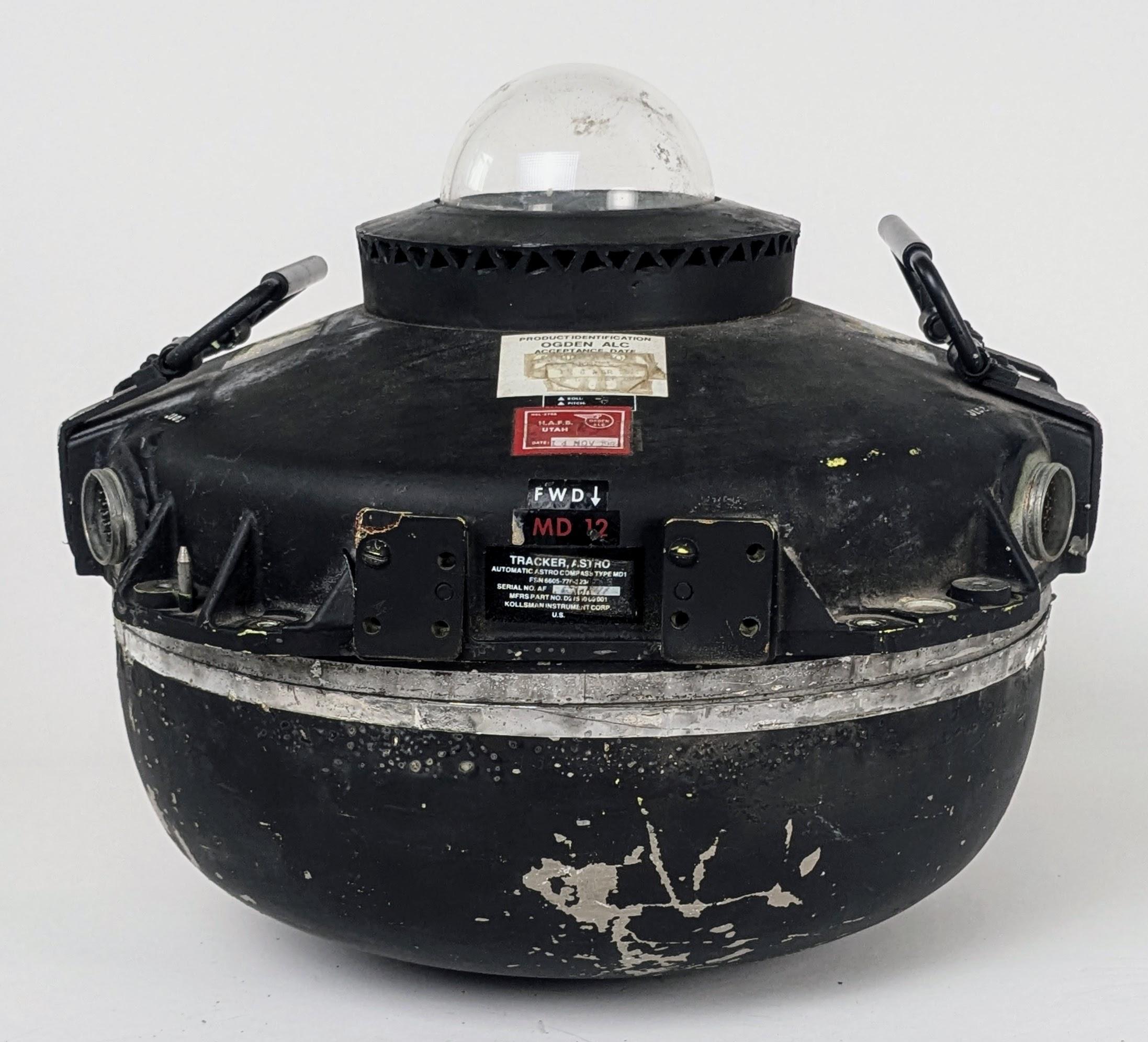
The Astro Tracker was mounted on top of the aircraft with the plastic bubble sticking out.

The Astro Tracker was mounted on top of the aircraft with the plastic bubble sticking out.

The Astro Compass navigation system was built around the "Astro Tracker" (above), the optical system that tracks a star. The Astro Tracker was mounted on the aircraft with the 4-inch glass dome protruding from the top of the fuselage. This unit contains a tracking telescope, which used a photomultiplier tube to detect the light from a star. A gyroscope and a complicated system of motors provided a "stable platform", keeping the telescope precisely vertical even as the aircraft tilted and moved. A prism rotated and tilted to aim the telescope at a particular star.3
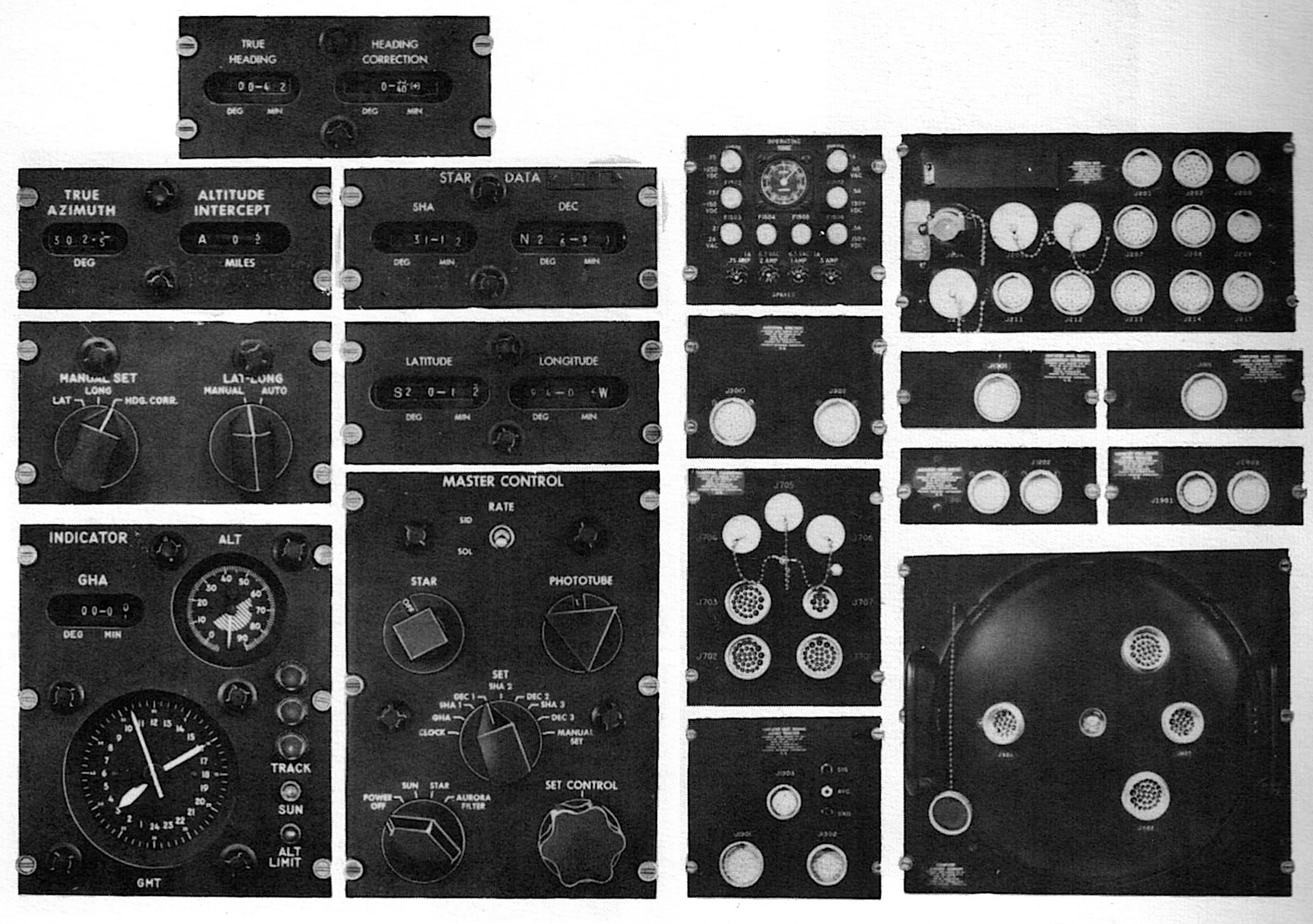
Star tracker instruments in the B-52 navigator's instrument panel: Line of Position display, Master Control panel, Heading Display panel, and Indicator Display panel. From Kollsman MD-1 Automatic Astro Compass Manual.

The Astro Compass system is bewilderingly complicated, consisting of 19 components (above) to support the Astro Tracker.4 On the right are the ten amplifier and computer components that controlled the system; the Angle Computer is in the lower right. On the left are the nine control and indicator panels that were used by the B-52's navigator. The photo below shows four of these panels in use in a B-52 in 1972.
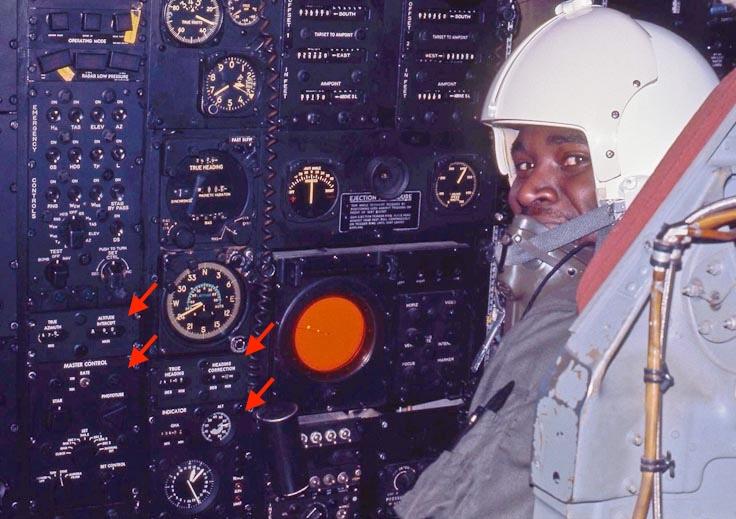
The navigator's station in a B-52. Some of the Astro Compass controls are indicated with arrows: the Line of Position display and the Master Control on the left, and the Heading display and Indicator display to the right. The navigator in this photo is Carl Hanson-Carnethon. From Rob Bogash's B-52 photo album. This specific B-52 (#2584) is now at The Museum of Flight, Seattle, but the Astro Compass is no longer present.

The navigator's station in a B-52. Some of the Astro Compass controls are indicated with arrows: the Line of Position display and the Master Control on the left, and the Heading display and Indicator display to the right. The navigator in this photo is Carl Hanson-Carnethon. From Rob Bogash's B-52 photo album. This specific B-52 (#2584) is now at The Museum of Flight, Seattle, but the Astro Compass is no longer present.

Controlling the Astro Compass

The Astro Compass has an interesting user interface, letting you input one value at a time by rotating a knob. First, you use the Master Control Panel to select a data value such as the clock time, SHA (Sidereal Hour Angle) for star #1, or Declination for star #3. Then you turn the "Set Control" knob clockwise or counterclockwise to scroll through the data values until the proper value is reached. Each knob on the Master Control Panel has a different geometrical shape, allowing the user to distinguish the knobs by feel. The Master Control Panel is visible in the lower left corner of the photo above, within easy reach of the navigator.
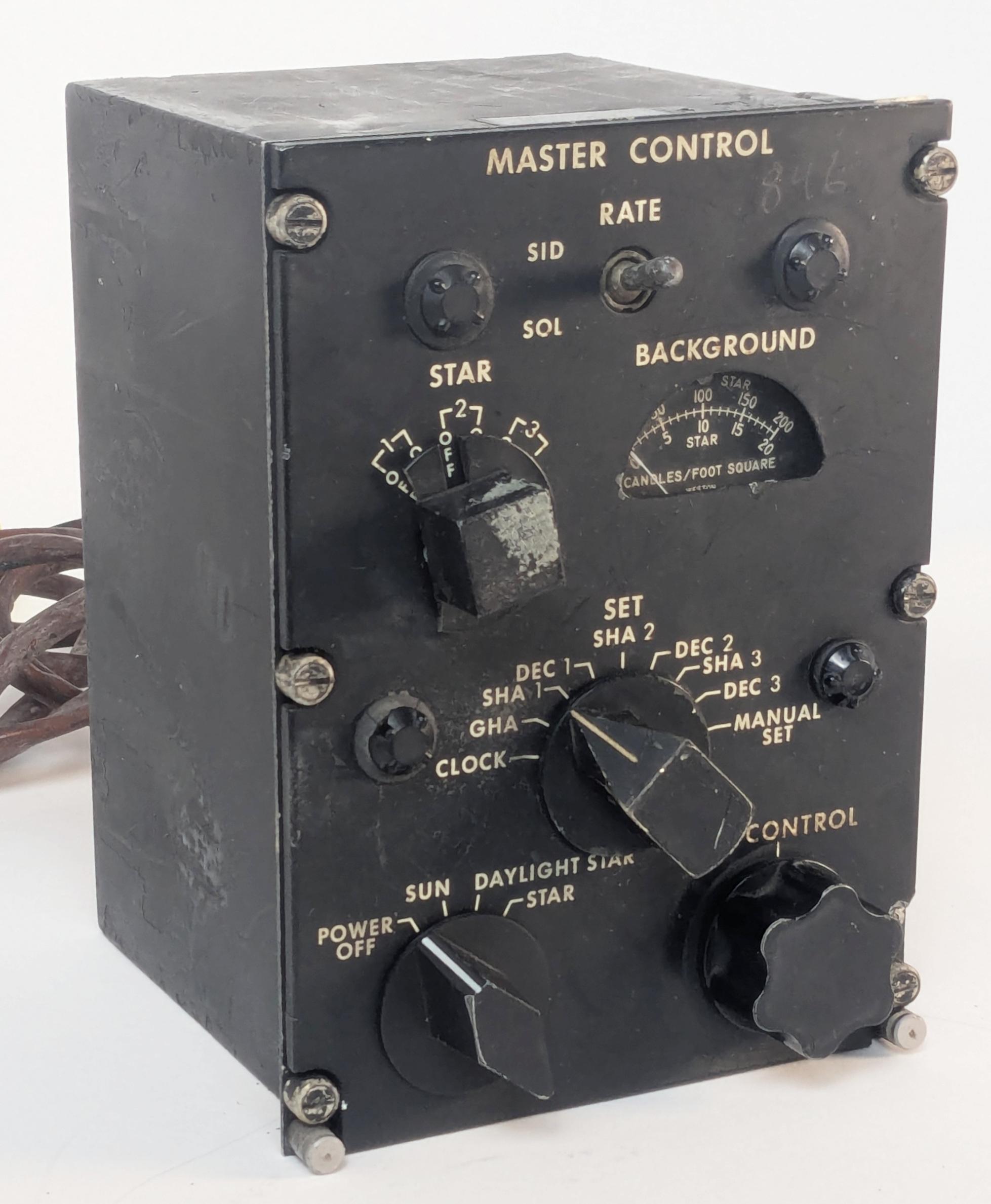
The Master Control Panel is the main interface to the Astro Compass.

The Master Control Panel is the main interface to the Astro Compass.

Each data value has a separate electromechanical display. The photo below shows a Star Data display, indicating the sidereal hour angle and the declination for a star. I removed the cover so you can see how the digital display actually consists of analog dials rotated by motors under synchro control. The system has three Star Data displays, so it can hold the positions of three stars at a time. Getting fixes from three different stars is useful when computing lines of position. The system uses one star at a time, but you can quickly change stars by flipping the Star switch on the Master Control Panel.
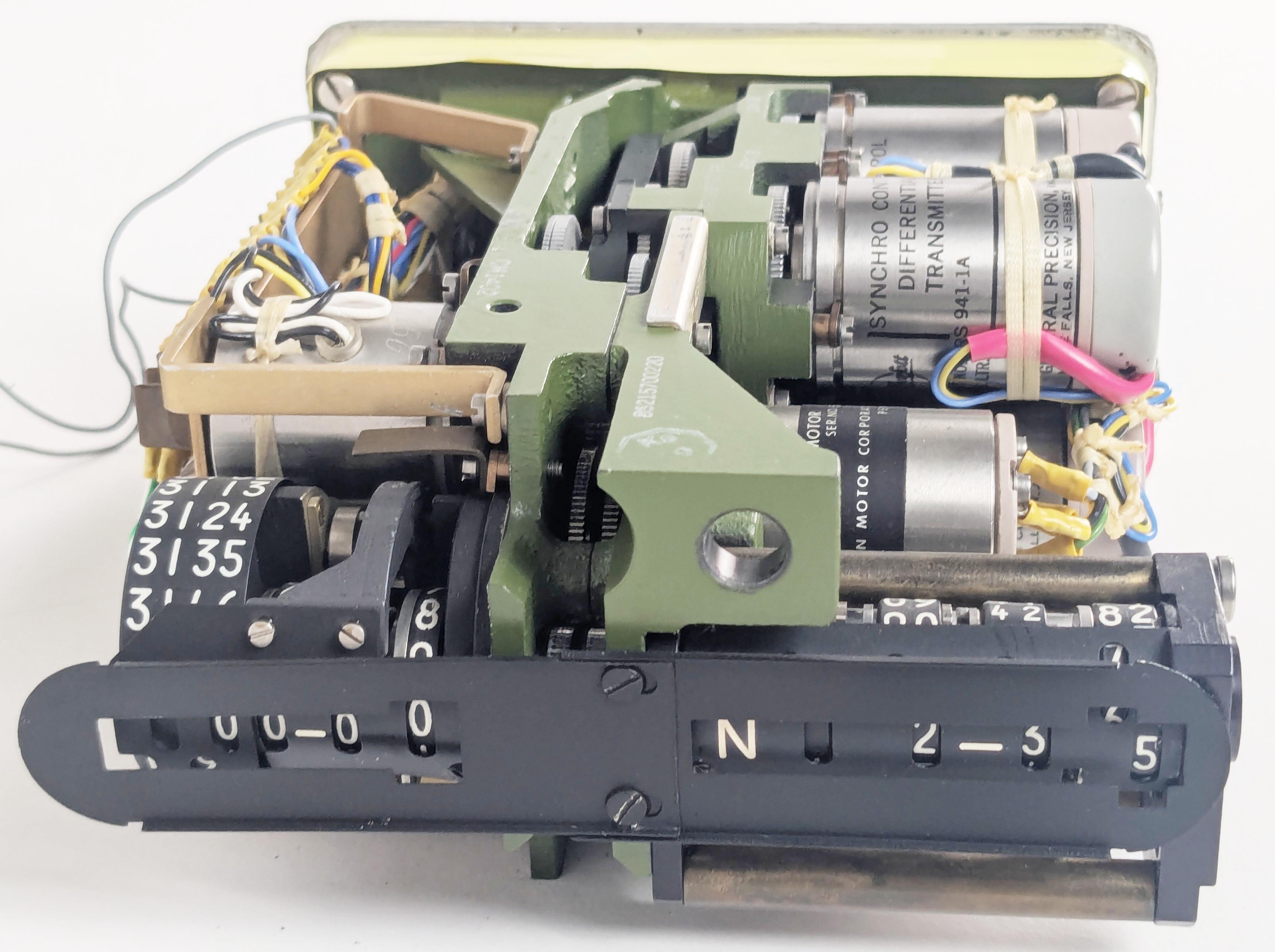
A Star Data display with the cover removed.

A Star Data display with the cover removed.

But how did the navigator obtain the information to put into the Astro Compass, since the sun, moon, stars, and planets are in constant motion?5 The necessary celestial information is published in a book called the Air Almanac. The US Government started publishing the Air Almanac in 1941, issuing a new volume every four months. The Almanac had a sheet for each day, providing celestial data on 10-minute intervals. The first column has the time (GMT, Greenwich Mean Time)6 while the other columns give the position of the sun, an important value called the First Point of Aries (symbol ♈︎), the positions of the visible planets, and the position of the moon. A separate table and chart provided the locations of stars; the stars don't have daily updates since they are almost stationary.7 (The Air Almanac is now online; you can download the 2026 Air Almanac here.)
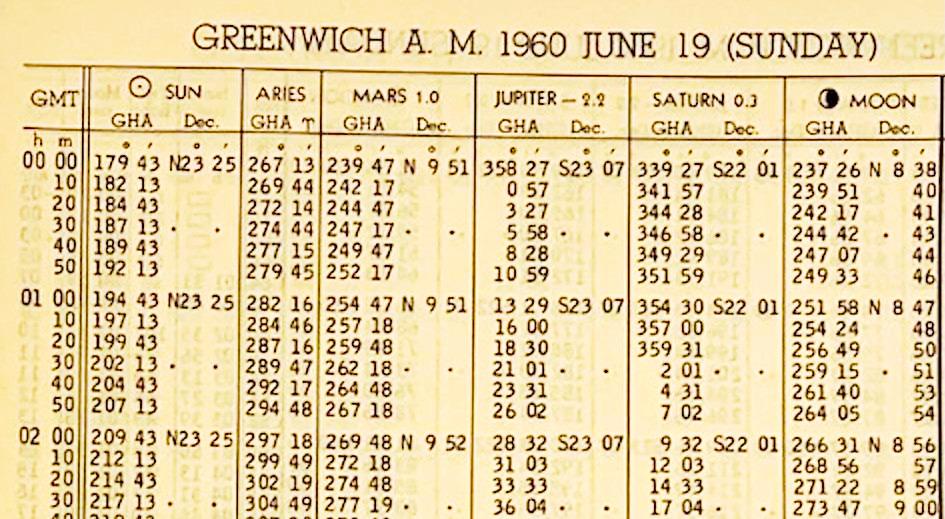
An excerpt from the 1960 Air Almanac. Photo used with permission from tanasa2022, who is selling the Almanac on eBay.

An excerpt from the 1960 Air Almanac. Photo used with permission from tanasa2022, who is selling the Almanac on eBay.

The navigational triangle: Computing a star's position

The Air Almanac provides star coordinates in a global coordinate system, but the Astro Compass needed to know star coordinates in the aircraft's local coordinate system. Determining the star's position requires changing the coordinate system by using spherical trigonometry and something called the navigational triangle. There's a fair bit of terminology involved, which I'll explain in this section.

The Astro Tracker, like many telescopes, is aimed by using azimuth and altitude. Suppose you go into your yard, point at the horizon, and turn 360° in a circle; the direction you're pointing is called the azimuth. The point directly overhead is called the zenith. Now swing your arm upwards 90° from the horizon to the zenith. That angle is called the altitude. (Confusingly, the term "altitude" is used both for the angle of a star and the height of an aircraft.) Thus, if you point at a particular star, you can describe its position with two angles: your horizontal rotation from north gives the azimuth, and the angle up from the horizon gives the altitude.8 This system is called the horizontal coordinate system, as it is based on the horizon. (The word "horizontal" comes from "horizon", by the way.) This is a local coordinate system since other locations will have a different azimuth and altitude for the star. The azimuth and altitude constantly vary with time because the Earth's rotation makes the star appear to move.

The equations for the altitude and azimuth are complicated, with sines, cosines, arcsine, and arctangent. To see why the equations are complicated, consider a time-exposure photo of star trails. As the Earth rotates, each star forms a circle around Polaris, the North Star. To trace out this circular path, the altitude and azimuth vary in a trigonometric way. This computation is performed electromechanically by the Angle Computer, as will be explained later.
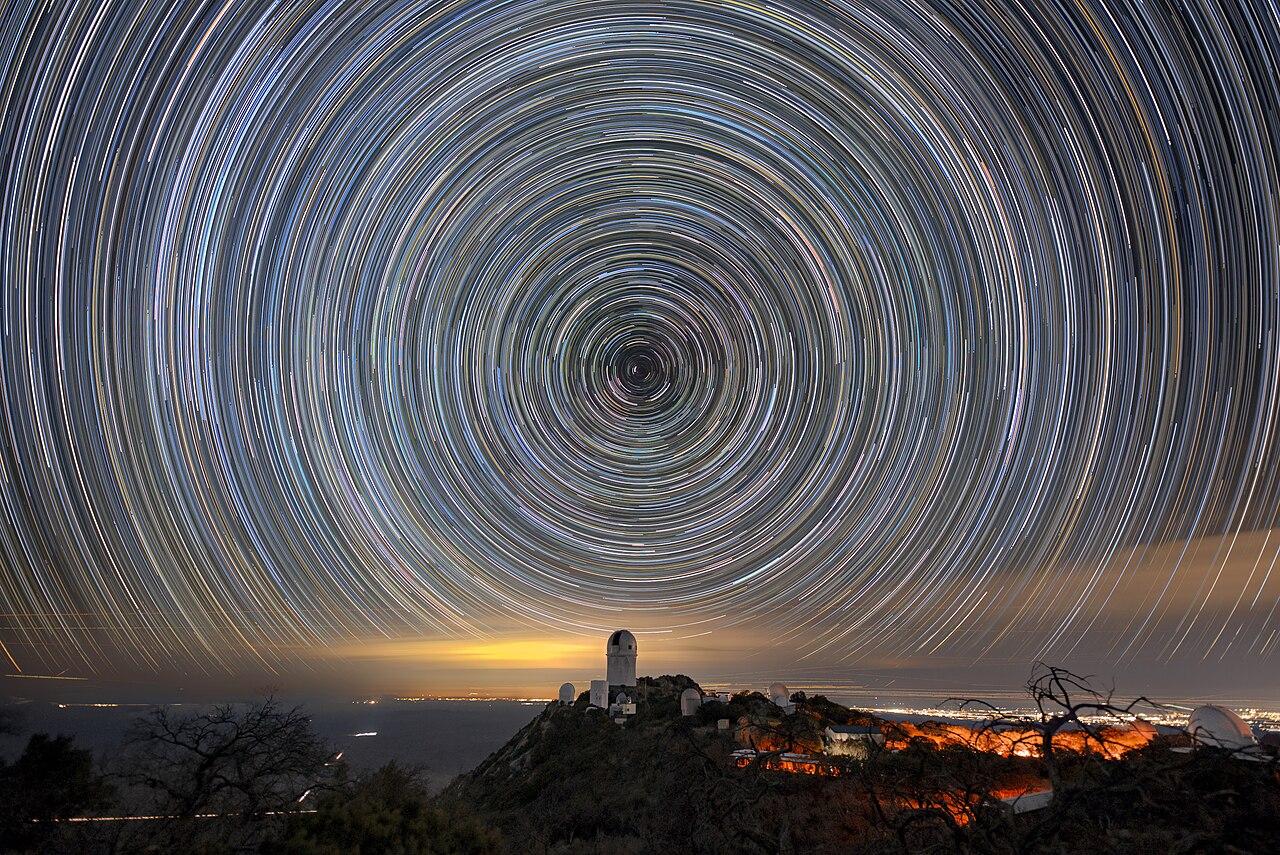
Kitt Peak National Observatory beneath star trail. Credit: DESI Collaboration/DOE/KPNO/NOIRLab/NSF/AURA/L. Tyas, CC BY 4.0.

Now let's switch to how the position of a star is defined in the Air Almanac (for example), independently of your local position. Pretend that the stars are on the surface of a large sphere that surrounds the Earth, called the celestial sphere. The stars are stationary on the surface of the celestial sphere, while the Earth rotates once a (sidereal)9 day in the middle. Thus, as you look up at the celestial sphere, you see the stars moving. You can extend the Earth's equator out to the celestial sphere, defining the celestial equator. Likewise, the celestial sphere has celestial poles, matching the Earth's poles. On the Earth, you specify a location (such as the airplane's location) with latitude and longitude (red). Latitude is measured from the equator, and longitude is measured from a fixed meridian (orange). The 0° meridian is arbitrarily defined to pass through Greenwich (England, not Connecticut). Similarly, the position of a star is specified by the angle from the celestial equator (called declination instead of latitude) and the angle from the meridian (called the sidereal hour angle or SHA instead of longitude).10
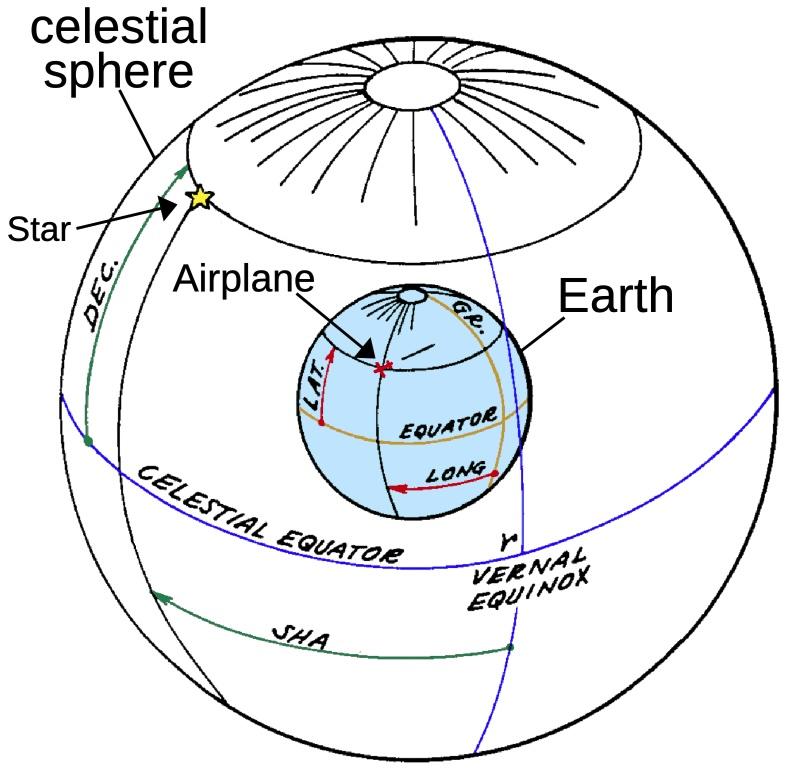
The celestial sphere, with the Earth at the center. The position of a star is described by Sidereal Hour Angle and declination, analogous to longitude and latitude describing the position of, say, an airplane on the Earth. The diagram is based on patent 2998529, "Automatic astrocompass".

The celestial sphere, with the Earth at the center. The position of a star is described by Sidereal Hour Angle and declination, analogous to longitude and latitude describing the position of, say, an airplane on the Earth. The diagram is based on patent 2998529, "Automatic astrocompass".

But what meridian is the starting point—0°—when measuring a star's Sidereal Hour Angle? The celestial equator matches the Earth's equator, but this won't work for the Greenwich meridian because it is constantly in motion. Instead, the 0° celestial meridian is arbitrarily defined as the position where the sun crosses the equator at the vernal equinox (the start of spring). If you consider the position of the sun on the celestial sphere, the sun will travel around the sphere once a year. Because the Earth's axis is tilted, the sun will be above the equator half the year and below the equator half the year, crossing the equator at the vernal equinox (March) and the autumnal equinox (September).

This reference point on the celestial sphere is called the First Point of Aries, represented by the symbol ♈︎ (horns of a ram); you might remember this symbol from the Air Almanac. At this point, the sun is in the constellation Pisces. So why is this point called the First Point of Aries and not Pisces? Back in 130 BCE, the ancient Greek astronomer Hipparchus defined the First Point of Aries as the starting point for the sun's motion. In that distant era, the sun was in the constellation Aries at the equinox, not in Pisces as it is today. It turns out that the direction of the Earth's axis isn't fixed, but moves in a 26,000-year cycle called the precession of the equinoxes.11 A 26,000-year cycle may seem irrelevant, but it's fast enough that the sun has moved from Aries to Pisces since Hipparchus's time. (And the equinox has moved 1° more since the B-52 was first produced!)

(All this talk of Aries and Pisces may sound like astrology, and, yes, there is a direct connection. Aries is the first zodiac sign, starting at the vernal equinox, typically March 21. The equinox's precession is "backwards", so the equinox has moved to Pisces, the last zodiac sign. Astronomically, the equinox will move into the constellation Aquarius around 2600 CE, but astrologers disagree on whether the Age of Aquarius has started; perhaps the 1960s was the dawning of the Age of Aquarius.)

How do you convert the star's fixed coordinate to the Earth's rotating coordinate? First, you look up the angle between the Greenwich meridian and the celestial meridian of Aries at a particular time. This angle (purple) is called the Greenwich Hour Angle of Aries (GHA ♈︎). Next, you look up the star's Sidereal Hour Angle (SHA). Adding them gives you the star's Greenwich Hour Angle (red), the angle between the Greenwich meridian and the star. Subtracting the aircraft's longitude gives you the Local Hour Angle (LHA, not shown), the angle between the aircraft's meridian and the star. (Note that these steps are simply addition and subtraction, so a mechanical system can easily do them with differential gears.)
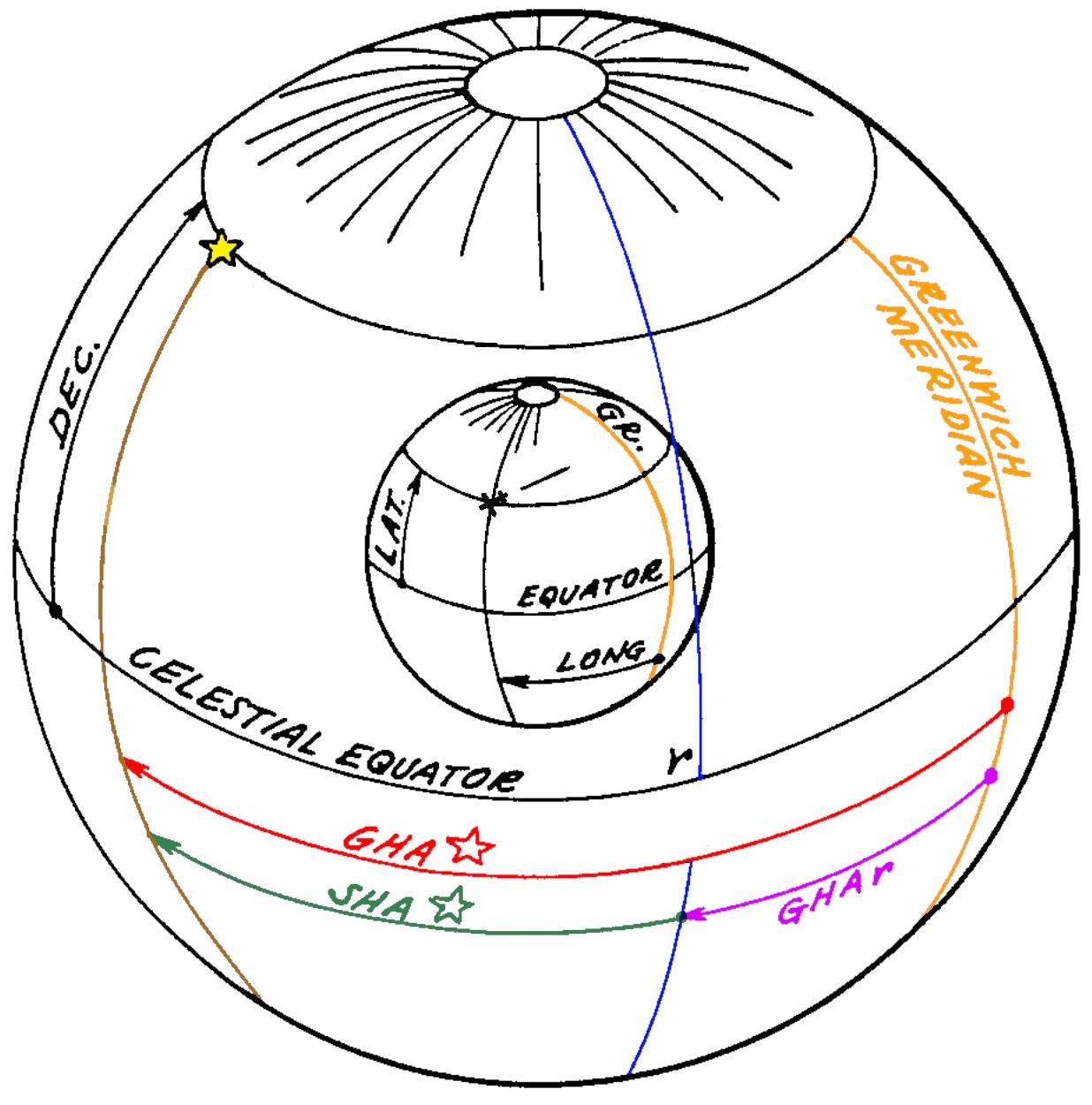
Computing the Greenwich Hour Angle of the start on the sphere.

Computing the Greenwich Hour Angle of the start on the sphere.

The final step, obtaining the azimuth and altitude, requires tricky spherical trigonometry. The yellow triangle is the navigational triangle, a spherical triangle on the surface of the celestial sphere. The upper vertex is the North Pole, the red vertex is the airplane's zenith (i.e., directly above the airplane), and the final vertex is the star. Two sides of the triangle and an angle (purple) are known, so the remaining angles and sides can be solved with spherical trigonometry. Specifically, the first side (purple) is 90°-declination, the second side is 90°-latitude,12 and the angle between is the LHA (Local Hour Angle). Solving for the angle at the zenith gives the azimuth (blue), while solving for the third side gives 90°-altitude (green, the angle down from the zenith to the star).
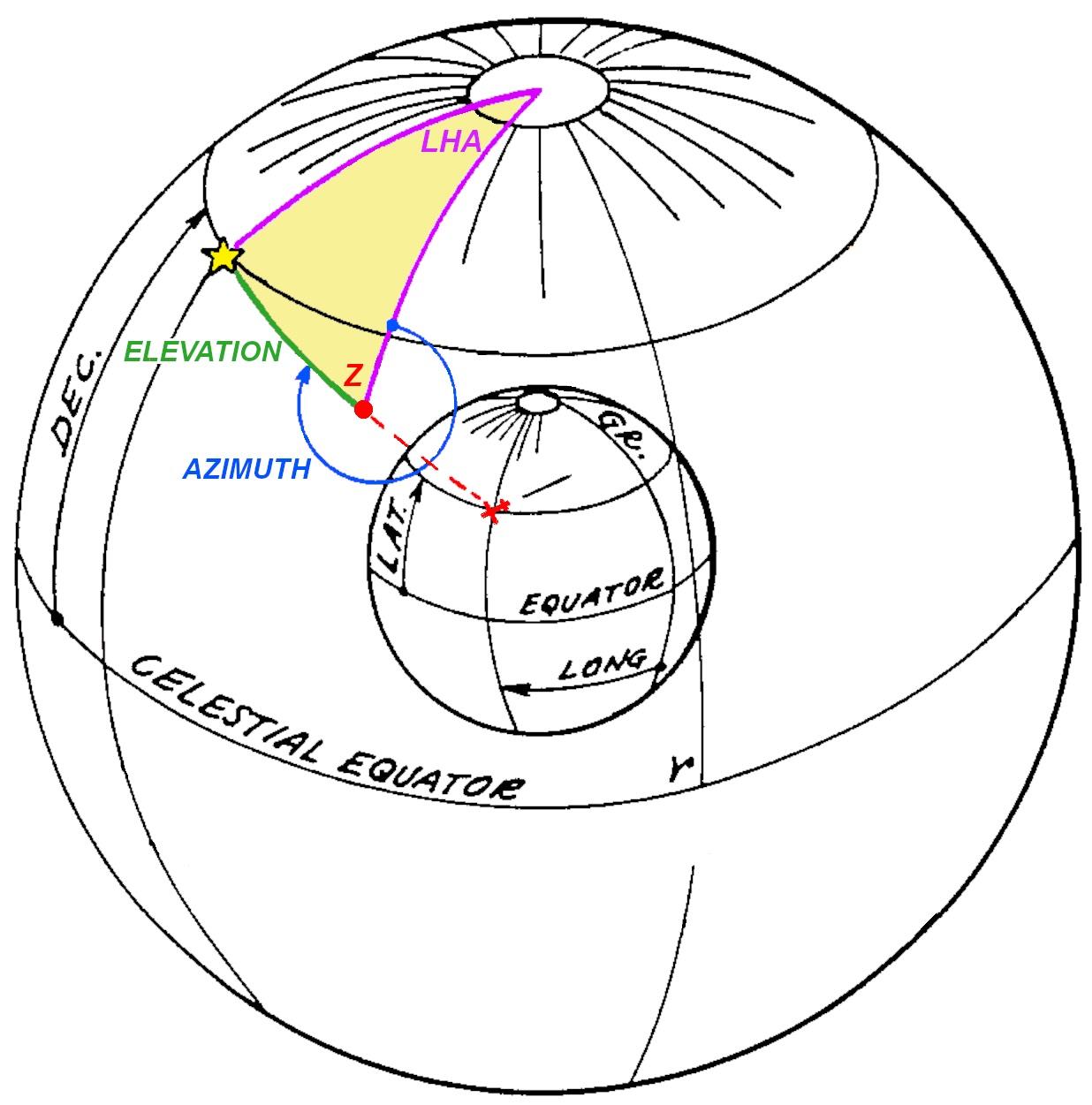
By solving the navigational triangle, the altitude and azimuth can be obtained.

By solving the navigational triangle, the altitude and azimuth can be obtained.

Thus, the key problem is solving the navigational triangle. Navigators could solve the navigational triangle by looking up angles in a thick book of "sight reduction" tables and performing some math. But how could the process be automated? That was the purpose of the Angle Computer.

The Angle Computer

The job of the Angle Computer was to solve the navigational triangle mechanically. Its inputs were the star's declination, altitude, and local hour angle. From these, it computed the star's altitude and azimuth at the aircraft's current position.13

The concept behind the Angle Computer is that it physically modeled the celestial sphere with a half-sphere, 2 5/8" in radius. A star pointer was mechanically positioned on the surface of this sphere, using the star's declination and local hour angle, adjusted by the latitude of the viewer. The star pointer moved a readout mechanism that translated the star's position into the azimuth and altitude at the specified location. Thus, the Angle Computer mechanically converted between the coordinate systems by using a physical representation, solving the navigational triangle.

The diagram below shows how the star pointer is positioned on the two-dimensional surface of the sphere, using a complicated mechanism inside the sphere. The U-shaped declination arm swings up and down, corresponding to the star's declination (angle above the celestial equator). Meanwhile, the declination arm constantly rotates around the polar axis, as specified by the LHA (Local Hour Angle). In one (sidereal) day, the mechanism will make a full cycle, corresponding to the Earth's spin. Finally, the latitude arm moves the mechanism up or down, corresponding to the viewer's latitude. On the right, three gears provide the inputs for latitude, LHA, and declination.
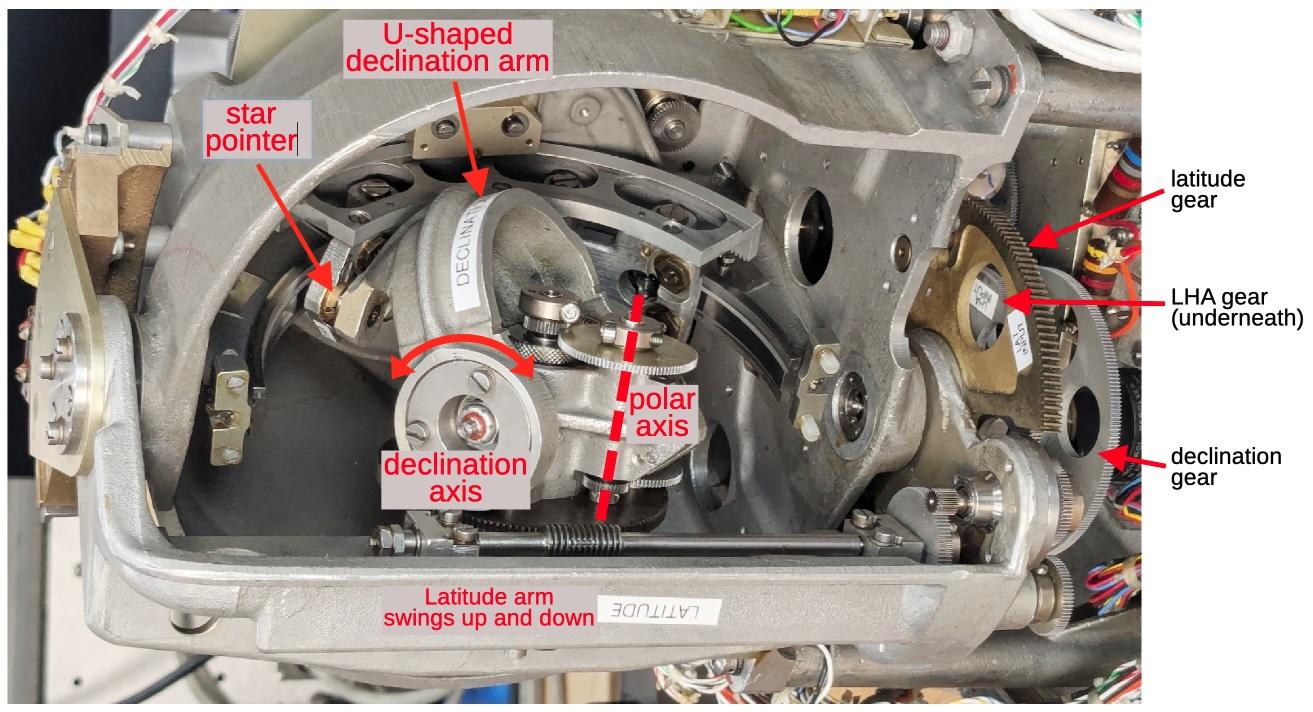
The input mechanism for the Angle Computer. The photo has been rotated 90° to better match the
Earth's rotation. Rotation around the polar axis corresponds to the Earth's daily rotation. Note that the star pointer will hit the end of the semicircular azimuth arc at some point; this corresponds to the star moving to the horizon and setting.

The input mechanism for the Angle Computer. The photo has been rotated 90° to better match the Earth's rotation. Rotation around the polar axis corresponds to the Earth's daily rotation. Note that the star pointer will hit the end of the semicircular azimuth arc at some point; this corresponds to the star moving to the horizon and setting.

A separate mechanism provides the altitude and azimuth outputs, driven by the star pointer. The key is the semicircular azimuth arc, which represents the arc from the viewer's horizon to the zenith, oriented to a particular azimuth. The star pointer is attached to the azimuth arc through a slider, so as the star pointer moves, it moves the slider along the azimuth arc and also rotates the azimuth arc. Specifically, the azimuth arc represents the line from the horizon to the zenith at a particular azimuth. The position of the slider on the azimuth arc corresponds to the altitude, from 0° at the horizon to 90° at the zenith.14. The azimuth arc rotates around the zenith point, which is at the back of the azimuth arc; this rotation indicates the azimuth value. As the azimuth arc rotates, it turns a gear at the zenith, providing the azimuth output. The slider arc has teeth on it; as the slider moves, these teeth rotate a second gear, providing the altitude output.
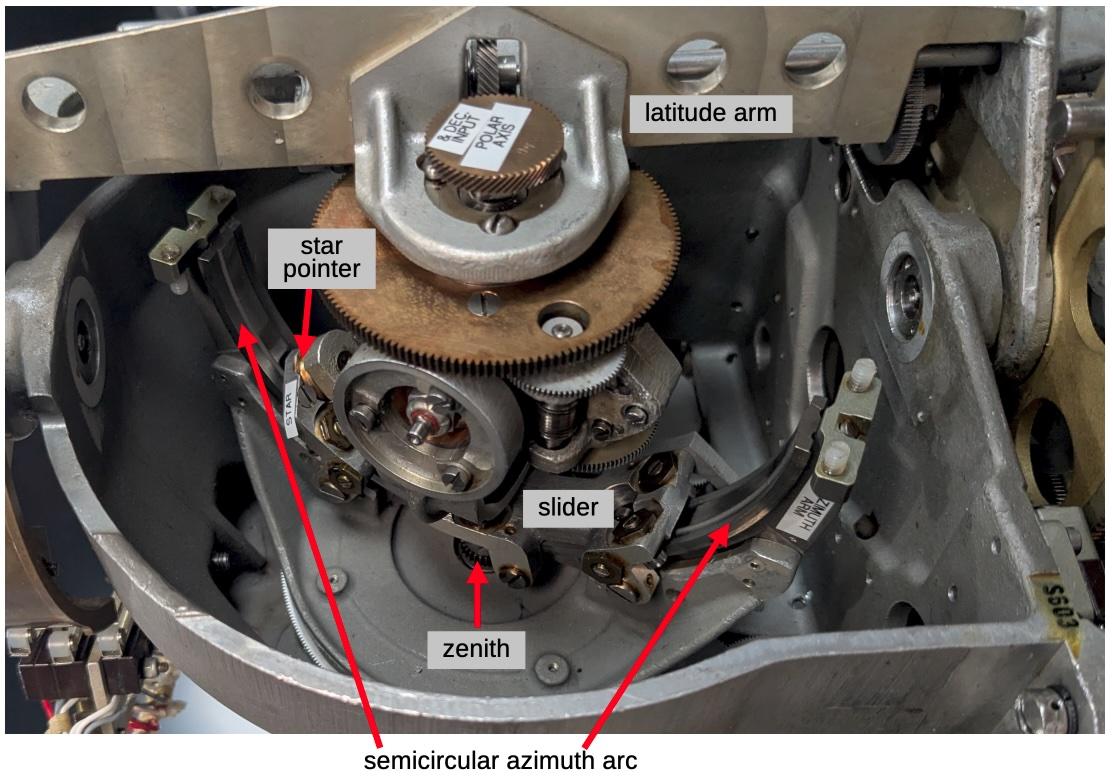
The output mechanism for the Angle Computer. The mechanism is in a different position from the
previous diagram. In particular, the latitude arm has been raised to a near-polar latitude and the photograph is from
the other side of the latitude arm. At this latitude, the polar axis is almost lined up with the zenith. As the LHA changes, the star will move in a circle, rotating the azimuth arc but causing little change in altitude. This corresponds to the real world situation of stars moving in a cirle around the zenith, if you're near the pole.

The output mechanism for the Angle Computer. The mechanism is in a different position from the previous diagram. In particular, the latitude arm has been raised to a near-polar latitude and the photograph is from the other side of the latitude arm. At this latitude, the polar axis is almost lined up with the zenith. As the LHA changes, the star will move in a circle, rotating the azimuth arc but causing little change in altitude. This corresponds to the real world situation of stars moving in a cirle around the zenith, if you're near the pole.

From the back, the numerous synchro transmitters, synchro control transformers, and motors are visible. Even though the computation itself is mechanical, the Angle Computer has numerous electrical components. In the top half, the synchro transmitters provide electrical outputs of the azimuth and altitude. (A synchro transmitter uses fixed and moving coils to convert a shaft rotation angle into a three-wire electrical signal.) The large gear provides the altitude output. In the lower half, the longer cylinders are motors that move the Angle Computer's mechanisms. The motors are directed to rotate to a particular position through a feedback loop: synchro control transformers provide feedback to the external servo amplifiers that power the motors.
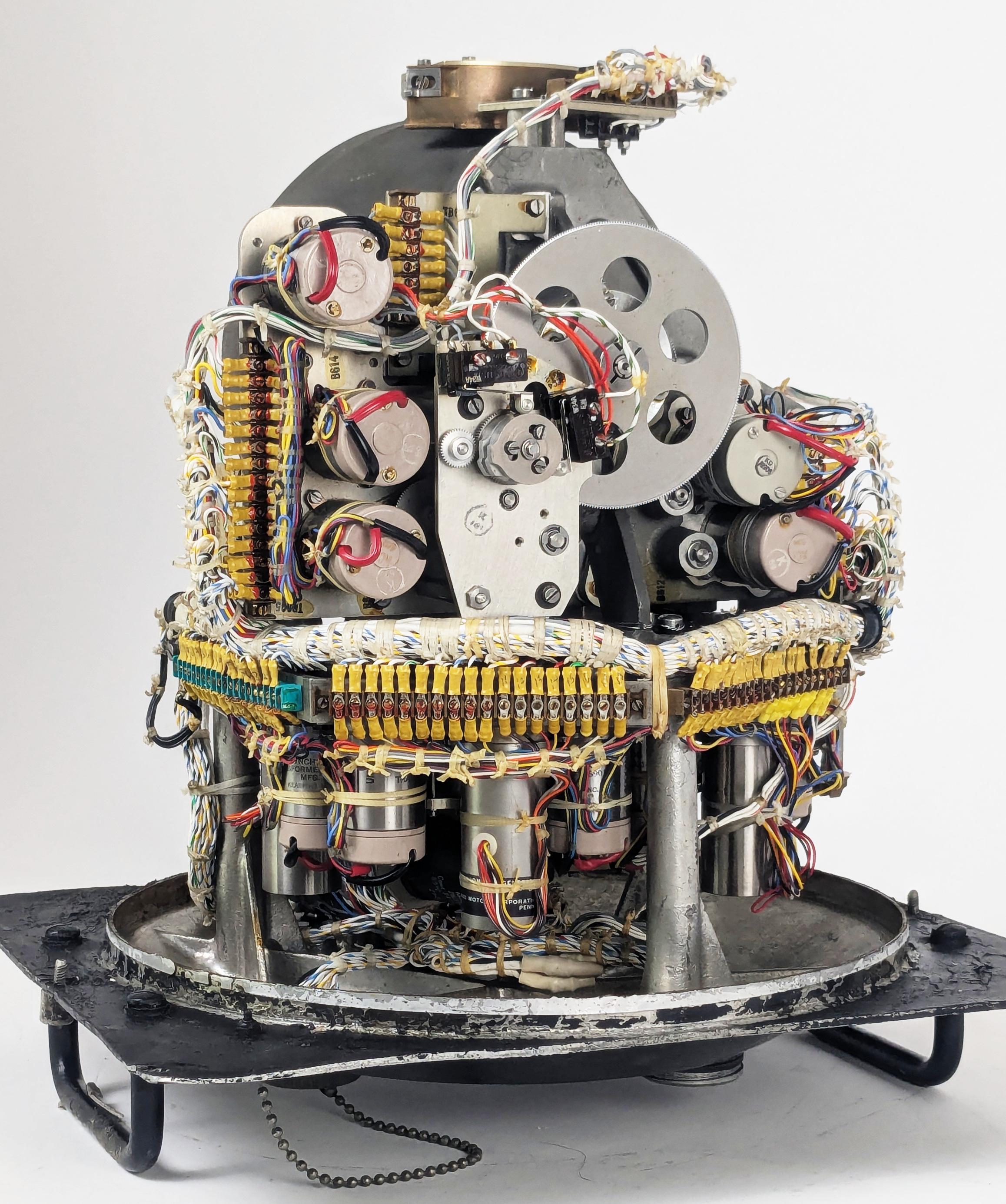
The back of the Angle Computer.

The back of the Angle Computer.

Partially disassembling the Angle Computer shows the complex gear trains inside, linking the synchros, motors, and the physical mechanism. The squat brass-colored units in the lower center are differential assemblies to add or subtract signals.15 One of the drive motors, a long cylinder, is visible in the lower right.
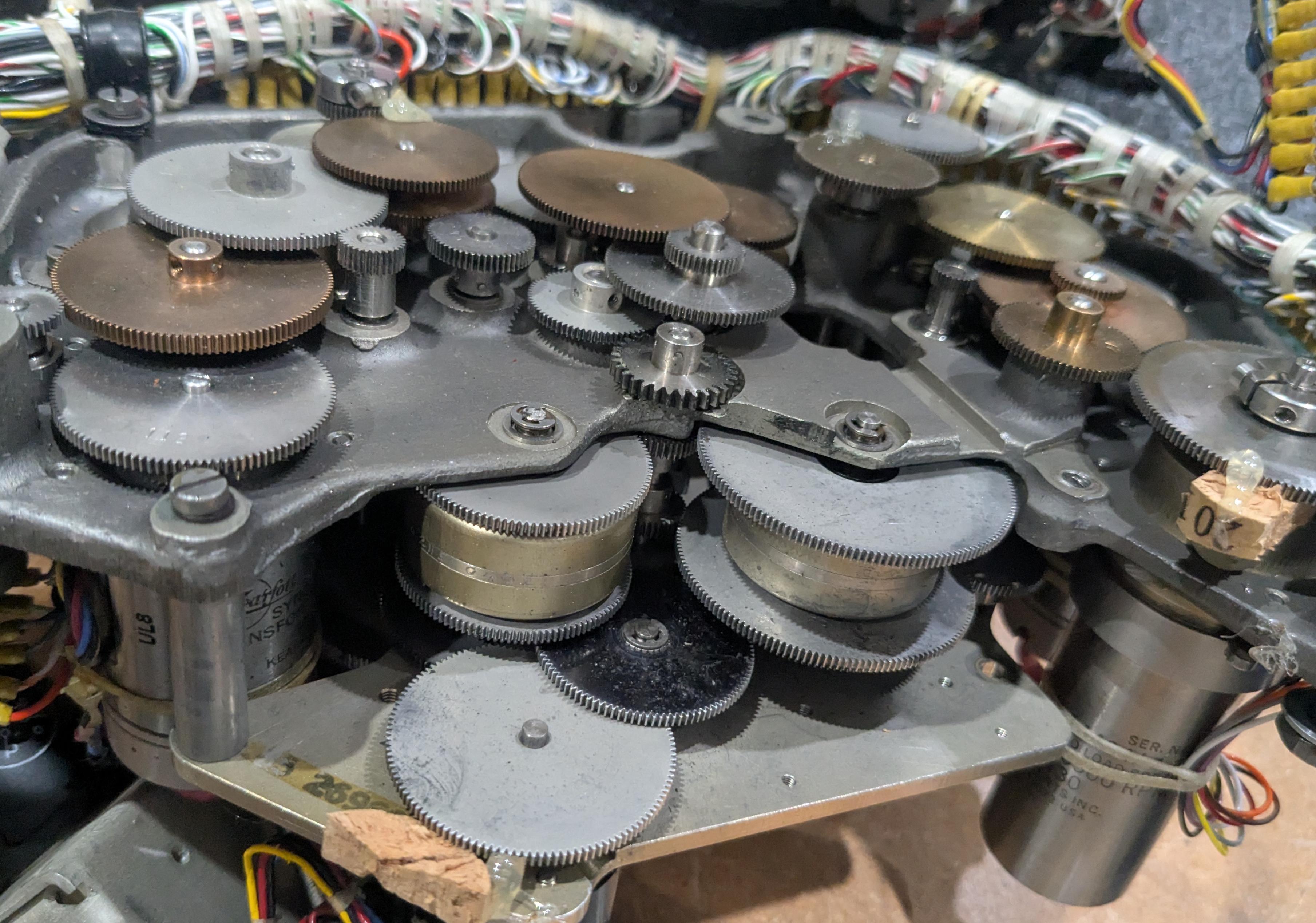
Gear trains inside the Angle Computer.

Gear trains inside the Angle Computer.

The Line of Position

Although the heading was the primary output from the Astro Compass, the Astro Compass could also help determine the location of the aircraft, using a technique called the celestial line of position. This technique was discovered in 1837 and became heavily used for navigating ships with a sextant. It could also be used onboard an aircraft.

To understand the line of position, suppose you go outside and find a star directly overhead. If you measure the altitude—the angle from the horizon to the star—with a sextant, the angle will be 90°, since it is overhead. Now, suppose you teleport 60 nautical miles away in any direction. The sextant will now show an altitude of 89° to the star, since a nautical mile is conveniently defined to match one minute of angle (one-sixtieth of a degree). Alternatively, if you measure an altitude of 89° to the star, you know you are 60 miles away from the original point under the star (called the sub-stellar point). Likewise, if you measure 88° to the star, you're on a circle with radius of 120 nautical miles around the sub-stellar point. If you measure, say, an altitude of 40°, you know you're on a very large circle with radius of 3000 miles around the sub-stellar point. So how does this help with navigation?

Suppose you're on a boat in the middle of the Pacific and you have a rough idea of where you are, say within 100 miles, but you want to find your exact position. Put a dot on the map where you think you are. Next, pick a star and work out what the angle to the star should be from your position. Measure the altitude with your sextant. Suppose you expected 50° but measured 51°. You now know that you're somewhere on a circle with radius of 2340 miles around the distant sub-stellar point. This doesn't seem very useful. However, since the angle was 1° more than expected, you know that the circle is 60 miles closer to that distant point than your estimated position. Moreover, since you have some idea of where you are, you know that you're on the part of this circle near your estimated location. And since you're looking at a small part of a big circle, you can approximate it by a line. So you can go back to your map, move 60 miles closer to the star from your estimated point, and draw a perpendicular line. This is your line of position, and you know that you're on this line (more or less).

Knowing that you're on a line isn't too useful, but you can repeat the process with a star in a different part of the sky. Maybe this time the angle is 2° smaller than expected, so you can draw a line of position 120 miles further away from your estimated position, in a different direction. The two lines cross, indicating a position where you (probably) are.16 Normally, you repeat the process with a third star, giving you three lines of position, providing a position and an idea of its accuracy.
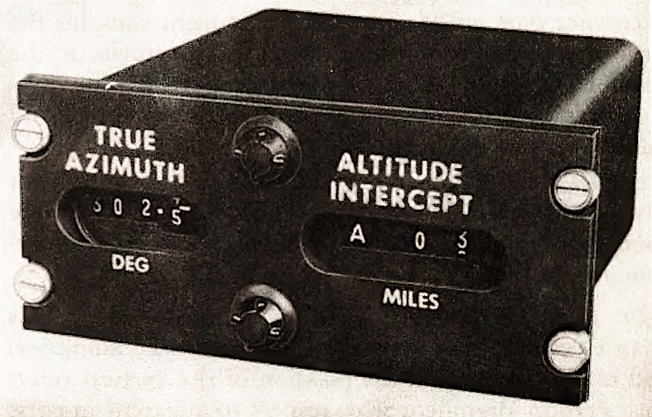
The Line of Position display panel. Remember that the altitude here has nothing to do with the aircraft's altitude. From Kollsman MD-1 Automatic Astro Compass Manual.

The Astro Compass used the display above to show the star's azimuth and the distance in miles from the assumed location to the line of position, called the Altitude Intercept. With this information, the navigator could draw a line of position on the map. The navigator repeated the process with two more stars to get a location fix.17

Conclusion

The Angle Computer is a relic from a time when a mechanical analog computer was the best way to solve a problem, but the computer was also electrical. Although a mechanical apparatus solved the navigational triangle, it was moved into position by motors, and the output was transmitted electrically through wires. Moreover, the Angle Computer was driven by electronic amplifiers and feedback circuits that used both vacuum tubes and transistors.

The designers of the Astro Compass considered multiple approaches to computing the navigational triangle (details). The first was to use small electromechanical devices called resolvers that convert a physical rotation into sine and cosine values. By combining six resolvers with amplifiers, the altitude and azimuth could be obtained. The resolver solution was rejected as being too large and requiring a precision power supply. The second approach was to use a digital computer to determine the solution. This solution was rejected because in 1963, a digital computer was expensive, slow, and less reliable. The final approach, which was adopted, was to build a mechanical, physical model of the celestial sphere. Thus, the Angle Computer resided at the uneasy intersection of physical mechanisms, electrical circuits, vacuum tubes, and solid-state electronics, soon to be obsoleted by digital computers.

I plan to write more about the Astro Compass system. For updates, follow me on Bluesky (@righto.com), Mastodon (@[email protected]), or RSS. Thanks to Richard for supplying the Astro Compass hardware.

AI statement: I didn't use AI to write this article (details).

Notes and references

Read the whole story
fxer
1 day ago
reply
Bend, Oregon
acdha
2 days ago
reply
Washington, DC
Share this story
Delete

At Long Last, InfoWars Is Ours - The Onion

3 Shares
Bryce P. TetraederBryce P. Tetraeder

Let me tell you a story. When I was a child, I suffered from night terrors. It was always the same dream: I could hear my family and neighbors wailing in the street outside as they were pursued and then destroyed by a nameless malevolent force, something neither I nor anyone else could control, a great darkness that was, somehow, all my fault.

Today, that childhood dream is finally coming true. Today I can finally say the sweetest nine or 10 words in the English language: Global Tetrahedron has completed its plan to control InfoWars.com.

I’ve had a lot of time to think about InfoWars in the last year and a half. As the seasons have changed, my ambitions for the project have grown grander, crueler, better aligned with market data. Come, friends, and imagine with me…

Imagine a roaring arena packed to the rafters with pathological liars. High above you in the nosebleeds are podcasters, screaming that you’ll die if you don’t buy their skincare products. Below, on the floor, imagine demonic battalions of super-influencers physically forcing people into home fitness devices designed to dismantle their bodies bone by bone and reassemble them into a grotesque statue of yourself. Out of the throngs, an extremely sick looking man approaches you. He puts his hands on your shoulders. He explains that he is your life coach and that you owe him $800.

Such is the InfoWars I envision: An infinite virtual surface teeming with ads. Not just ads, but scams! Not just scams, but lies with no object, free radical misinformation, sentences and images so poorly thought out that they are unhealthy even to view for just a few seconds. The InfoWars of old was only the prototype for the hell I know we can build together: A digital platform where, every day, visitors sacrifice themselves at altars of delusion and misery, their minds fully disintegrating on contact.

With this new InfoWars, we will democratize psychological torture, welcoming brutal and sadistic ideas from everyone, even the very stupidest among us. It will be like the Manhattan Project, only instead of a bomb, we will be building a website. 

The InfoWars of tomorrow will converge into a swirling vortex of content about content, talent acquiring talent, rings of concentric media mergers processing all human artistry into one endlessly digestible slurry. This will be a dank, sunless place, one where panic and capital feed on each other like twins in the womb of a hulking, unknowable monster—a monster known by many names, but which I like to call modern-day America.

All of this is to say that I believe in us. I believe that with the new InfoWars, we can alchemize the pioneering spirit of amateur inquiry, the profit-maximizing drive of corporations, and the cold mental clarity that comes only with disciplined daily ingestion of mind- and body-altering chemicals. If we can do that, what other great things can we do together?

I don’t yet know, but I’m excited to find out. Welcome home, warriors. The future belongs to us. We’re writing the story now. It’s going to be a long one, and it’s going to be a bad one.

So settle in. Make yourself comfortable. Buy a tote bag. 

Nothing can stop us now that we’re in charge of a website.

Infinite Growth Forever,

Bryce Tetraeder, CEO, Global Tetrahedron

Read the whole story
fxer
1 day ago
reply
Bend, Oregon
hannahdraper
1 day ago
reply
Washington, DC
acdha
7 days ago
reply
Washington, DC
Share this story
Delete

What Happened After The New York Times Found a Cartel Mine on a Colombian Military Base

2 Shares

Officers denied that an illegal, large-scale gold operation was underway within earshot of their posts. But we had seen it with our own eyes.

Illegal mining in and near a military base in northwestern Colombia.

Officers denied that an illegal, large-scale gold operation was underway within earshot of their posts. But we had seen it with our own eyes.

Illegal mining in and near a military base in northwestern Colombia.Credit...

It was during my third visit to La Mandinga, a gold mine controlled by a Colombian drug cartel, when I understood just how badly the institutions that are supposed prevent illegal mining had failed.

The mine abutted a Colombian military base. Weren’t people worried about operating under the noses of the authorities? After all, the mine supported the notorious Clan del Golfo cartel.

Hardly. One miner told me and my colleagues that the operation had even expanded beyond the military perimeter line and that workers were mining for gold directly on the base.

“Fly a drone and see,” the miner said.

So we did. The images were clear: Miners with high-pressure hoses were tearing up a forested area of the base, home to the Rifles Battalion 31, a Colombian military unit. We could see what appeared to be a former fence line — but no sign of a fence separating the base from La Mandinga. After we shared the images with the military and asked for comment, the base’s commander, Col. Daniel Echeverry, denied any gold mining was happening on his base.

Image

Miners working inside the perimeter of the base. The military denied this was happening.

Image

The mine’s diesel generators can be heard from the buildings on the base.

That made no sense to us. The diesel generators on a working mine are deafening and, from satellite imagery, we could see that the mines had expanded to within about 150 yards of the base’s swimming pool and outbuildings.

Colonel Echeverry invited me to the base to talk, so I went. He told me that in the six months he’d been in charge, he’d been aware of the illegal miners next door but noted that the military was hesitant to take armed action against civilians, even if they were committing crimes. But he was adamant that the miners were not on the base.

As a journalist, I’m not in the business of leading the authorities to the site of criminal activity. I never want to become part of the story. But here was a colonel denying, on the record, what I had seen with my own eyes.

So I asked if we could go for a walk.

I could hear the generators in the distance. After five minutes, the forest opened into a panorama of torn-up soil and muddy pits. Miners with high-pressure hoses were running a full-scale illegal gold-mining operation, just as we’d seen from the sky.

Image

The muddy mining pits on the right side of this photo are on military property. The operation has expanded steadily closer to the base’s swimming pool and outbuildings.

Image

Col. Daniel Echeverry investigating claims of mining.

Colonel Echeverry froze. “This is inside the base,” he said. He ordered the miners to leave. “We can shoot you for trespassing!” he shouted.

I don’t know whether the miners had been working there surreptitiously or whether they’d had an understanding with someone on the base. Either way, I expected them to scatter.

Instead, they shouted obscenities and kept working.

As we were on a military base, reinforcements were close by.

Soldiers arrived with gasoline canisters. They doused the mining equipment and lit it on fire.

“You can’t burn our equipment!” shouted a miner working in his underwear. He swore at the soldiers before grabbing his gold ore and running off.

Some miners pulled out machetes. Others threw rocks. The soldiers began cutting hoses with chain saws.

Workers tried to rescue their equipment and to extinguish the flames with buckets of muddy runoff.

Image

A miner tried to douse the fire, even as a soldier poured gasoline on the equipment to accelerate the flames.

Image

Soldiers trying to destroy the miners’ equipment as the miners tried to save it.

The miners pay the Clan del Golfo for the right to mine at La Mandinga. It was clear that, as far as many of them were concerned, they believed that right extended to where we stood — military property or not.

One miner threatened the colonel with a stick. Then he doused the soldiers and me with gas and shouted, “We’re all going to burn!”

The colonel said it was time to go. The soldiers and I retreated.

Image

Colonel Echeverry with his soldiers as they destroyed equipment.

Image

Some miners fought back and tried to rescue their gear.

Colonel Echeverry seemed shaken. He oversees about 800 men who are responsible for clamping down on the Clan and other armed groups in the area. The gold trade keeps those groups awash in arms and in control of the region.

We hadn’t come to La Mandinga to report on the military base. We came because we had learned that Clan del Golfo gold was making its way to the U.S. Mint, despite laws requiring the Mint to buy only gold mined in the United States.

Colonel Echeverry initially had the same reaction to our findings that many others in the gold supply chain had displayed. Like the Mint, the Mint’s suppliers and the exporters who send the gold to the United States, the colonel had insisted that there was no way illicit gold was moving right under his nose.

When we showed him the evidence, he, like everyone else, said he was surprised and promised to crack down.

It left us wondering: We had such an easy time tracking this gold. Were others even looking?

Image

Illegal gold mining inside the military base. The blue tarps are just outside the base’s perimeter.

Justin Scheck contributed reporting.

A version of this article appears in print on April 26, 2026, Section A, Page 11 of the New York edition with the headline: What Happened After The Times Found Miners on a Colombian Base. Order Reprints | Today’s Paper | Subscribe

Related Content

Advertisement

SKIP ADVERTISEMENT

Read the whole story
fxer
1 day ago
reply
Bend, Oregon
acdha
1 day ago
reply
Washington, DC
Share this story
Delete
Next Page of Stories